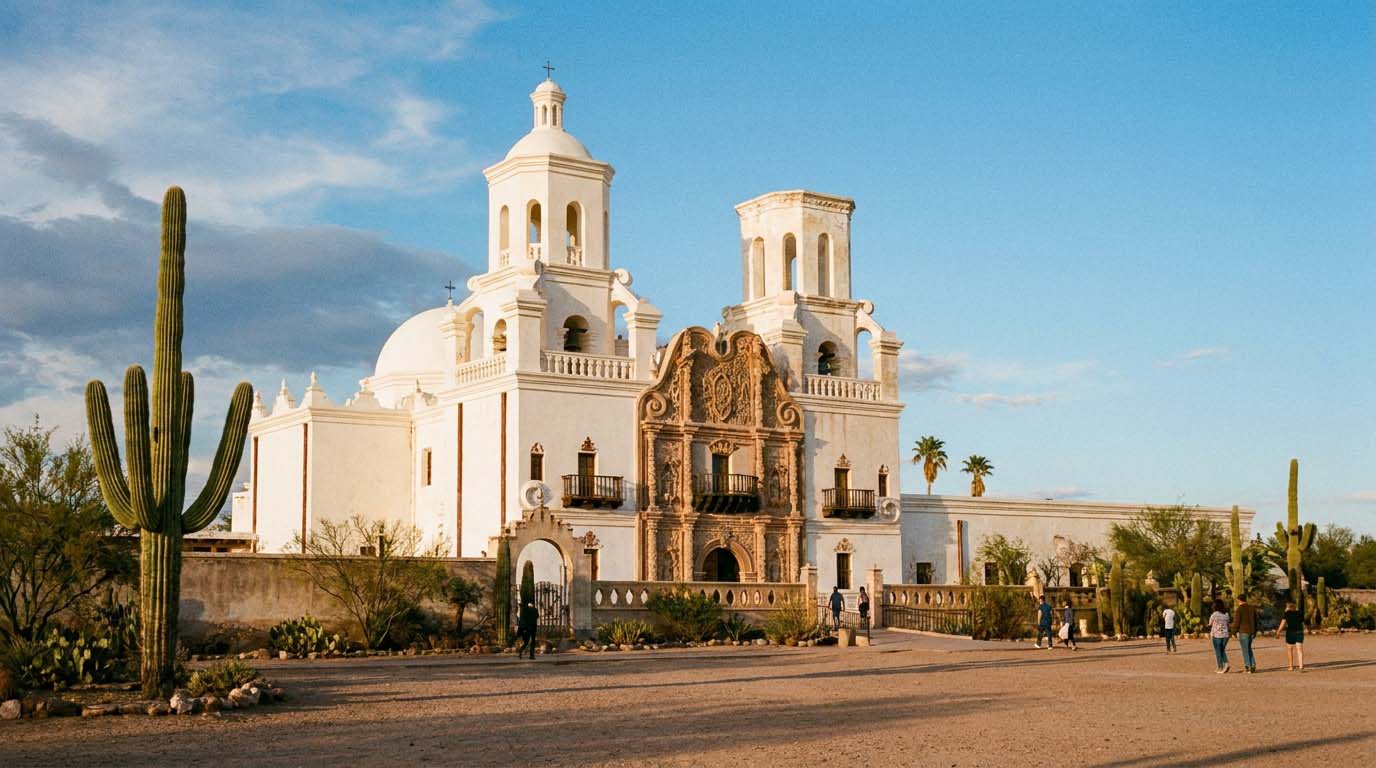
Tucson attractions are not limited to one downtown entertainment district or one tourist strip. The Old Pueblo is an attraction city because of the desert itself: saguaros, mountains, missions, aviation history, science institutions, museums, gardens, food culture, public art, trails, scenic drives, and seasonal events all overlap.
This guide is written for people moving into Tucson and the surrounding area. It is not a vacation itinerary, and it is not a ranking of every place to visit. More specific guides can cover individual destinations later. This is the orientation guide: what kinds of attractions exist here, what they say about Tucson, and how to think about them as a resident rather than as a one-time tourist.
The most important idea is simple:
In Tucson, the attraction is often the setting.
A museum, mission, trail, overlook, garden, or historic site usually means more when you understand the Sonoran Desert and the borderlands around it.
Tucson has several attraction layers:
Desert and mountain attractions.
National, state, county, and forest recreation areas.
Mission and heritage sites.
Aviation, military, and Cold War history.
Science, optics, astronomy, and research institutions.
Museums, gardens, and cultural attractions.
University-related attractions.
Family-friendly wildlife, zoo, and nature experiences.
Seasonal events, festivals, and visitor cycles.
Scenic drives and day-trip corridors.
That variety is one reason Tucson feels different from many desert metros. The city is not just a warm-weather place with restaurants and resorts. Its attractions are tied to real geography, deep history, science, military presence, Indigenous and Mexican heritage, and the unusual ecology of the Sonoran Desert.
Visit Tucson describes the region as having museums, historic sites, hiking trails, golf courses, gardens, zoos, the university campus, and distinctive desert flora and fauna. That broad mix is the right way to think about Tucson attractions: they are cultural, scientific, scenic, historic, and outdoor at the same time.
For many newcomers, Saguaro National Park is the visual definition of Tucson.
The park protects the giant saguaro cactus landscape on both sides of the city. The east district is in the Rincon Mountains area, and the west district is in the Tucson Mountains. The National Park Service explains that Saguaro National Park is uniquely situated around Tucson in the heart of the Sonoran Desert, with the park’s two districts separated by the city.
That split matters for residents. Saguaro is not one remote park far outside town. It frames Tucson on both sides. Depending on where you live, one side may become your regular sunset drive, family walk, photography spot, cycling route, or hiking base.
Saguaro National Park is best understood as a desert-landscape attraction, not a theme park. The experience is about scenic drives, visitor centers, short walks, longer hikes, cactus forests, mountain views, wildlife, sunsets, and learning how the Sonoran Desert works.
The park also teaches new residents a Tucson lesson: the desert is alive, but it is not casual. Heat, sun exposure, low humidity, rough trails, limited water, and flash-flood conditions can turn a simple outing into a problem if you treat the desert like a city park.
For people relocating to Tucson, proximity to Saguaro can shape lifestyle. Living near one of the park districts may mean easier access to trails and scenery, but it can also mean more wildlife awareness, more visitor traffic near access roads, more sensitivity to desert landscaping, and stronger interest in dark skies and open-space preservation.
Sabino Canyon is one of the Tucson area’s most important recreation attractions. The U.S. Forest Service describes Sabino Canyon Recreation Area as a place where visitors walk, jog, hike, view wildlife, take photographs, and use the canyon as a local outdoor destination.
For residents, Sabino is more than a tourist stop. It is a regular fitness route, family outing, desert classroom, photography location, visitor destination, and foothills landmark.
Sabino Canyon combines canyon scenery, mountain views, desert vegetation, seasonal water, paved and unpaved routes, wildlife, and shuttle-supported access. It is one of the easiest ways for a newcomer to experience the Santa Catalina Mountains without needing a remote backcountry plan.
Rules, fees, shuttle details, bicycle access, trail conditions, and weather conditions can change, so residents should check the current Forest Service or operator information before going. Summer heat, monsoon storms, flash-flood potential, and limited shade can all matter.
Homes near major recreation access points can feel amenity-rich, but popular trail areas can also create parking pressure, early-morning traffic, cyclists, pedestrians, and visitor activity. For many residents, that tradeoff is worth it. For others, it may be something to consider when choosing an area.
Mount Lemmon and the Santa Catalina Mountains are a major part of the Tucson attraction system.
The mountain drive gives residents a dramatic elevation change from desert floor to cooler forest environments. It is one of the most memorable local experiences because it shows how quickly the Sonoran Desert can shift into high-elevation pine, rock formations, overlooks, and cooler temperatures.
For Tucson residents, Mount Lemmon is often a heat escape, scenic drive, hiking area, cycling challenge, picnic destination, photography route, and seasonal novelty. It also helps newcomers understand the Sky Island concept: isolated mountain ranges rising out of desert and grassland landscapes, creating different habitats with elevation.
Mountain weather can be very different from city weather. Road conditions, fire restrictions, snow, closures, parking, and seasonal crowding should be checked before heading up. The same Tucson day can feel hot in town and chilly at higher elevation.
The mountain is one reason Tucson offers more than desert heat. Residents who like hiking, cycling, scenic drives, photography, cooler air, and mountain landscapes may find that access to the Catalinas becomes part of their daily or weekly quality of life.
The Arizona-Sonora Desert Museum is one of the best introductions to the region.
The museum describes itself as a fusion experience: zoo, botanical garden, art gallery, natural history museum, and aquarium. Its overview says the 98-acre museum includes more than 230 animal species, 1,200 varieties of plants, botanical gardens, aviaries, an aquarium, and an art gallery.
For someone new to Tucson, this attraction is valuable because it explains the Sonoran Desert as a whole system. It is not just animals in exhibits or plants in beds. It is a curated version of the region’s ecology, geology, wildlife, vegetation, and culture.
New residents.
Families.
Out-of-town guests.
Desert-curious homeowners.
People trying to understand native plants.
Visitors who want wildlife and landscape in one stop.
Anyone who wants a strong Tucson orientation.
Many Tucson homeowners inherit desert landscaping without knowing what they are looking at. A visit to the Desert Museum can make the local environment more understandable: saguaros, palo verdes, mesquites, ocotillo, desert animals, pollinators, water adaptation, shade, and habitat all become easier to read.
Mission San Xavier del Bac is one of the region’s most important historic and cultural attractions.
The mission’s own history describes it as founded by Padre Kino in 1692, completed in 1797, and still serving as a place of faith and community. The National Park Service notes that the present church was built by Franciscans between 1783 and 1797 at the Wa:c village of the O’odham.
For Tucson residents, San Xavier is not only a landmark. It is a living religious site, a restoration story, a community site, and a reminder that Tucson’s history is Indigenous, Spanish, Mexican, Catholic, and borderlands — not merely Old West.
Treat the mission with respect. It is not just architecture. It is an active faith community and a historic site connected to the Tohono O’odham community.
San Xavier helps new residents understand why Tucson’s identity feels older and more layered than a typical modern metro. The mission connects the city to O’odham history, Spanish colonial history, religious history, architecture, art conservation, and the broader Santa Cruz River valley.
Pima Air & Space Museum is one of Tucson’s signature attractions and one of the strongest expressions of the region’s aviation identity.
The museum describes itself as one of the largest non-government-funded aviation and space museums in the world, with hundreds of aircraft, six indoor exhibit hangars, and a large outdoor campus.
This attraction matters because Tucson is deeply tied to aviation, aerospace, defense, and military history. Pima Air & Space is not random entertainment. It reflects a real regional economic and cultural thread.
Aviation enthusiasts.
Military families.
Families with children.
History-minded visitors.
Engineering and technology-minded residents.
Out-of-town guests.
People interested in Tucson’s aerospace identity.
Because much of the collection is spread across a large outdoor campus, heat and walking distance matter. Visitors should plan for sun, water, comfortable shoes, and enough time.
The museum helps explain why the airport area, Davis-Monthan Air Force Base, defense contractors, aviation employers, and aerospace suppliers are such an important part of Tucson commerce.
The Titan Missile Museum, near Green Valley and Sahuarita south of Tucson, is one of the most unusual attractions in Southern Arizona.
The museum describes itself as the last of the 54 Titan II missile sites that were on alert across the United States from 1963 to 1987. Its visitor information also notes that guests must be able to safely descend and ascend 55 stairs because there is no elevator access to the underground silo.
This is not a casual roadside museum. It is a Cold War site that allows visitors to understand a specific era of U.S. military strategy, technology, and nuclear deterrence.
Military history visitors.
Cold War history enthusiasts.
STEM-minded families.
Visitors looking for something unique.
Residents who want to understand Southern Arizona’s defense history.
Because tour access, reservations, stairs, and accessibility limitations matter, visitors should check current requirements before going. This is especially important for seniors, mobility-limited visitors, and families with young children.
The Titan Missile Museum is another reminder that Tucson’s attractions are not generic. They are tied to the actual history and economy of the region: aerospace, defense, borderlands geography, open desert, and federal investment.
Biosphere 2 is one of the region’s major science attractions.
Biosphere 2 describes itself as a research and learning site focused on Earth systems, interactive education, and tours. Its self-guided tour information describes a walking route with indoor and outdoor portions, stairs, varying weather conditions, and biome environments that can be hot and humid.
For new residents, Biosphere 2 is useful because it connects Tucson’s desert setting to global environmental science. It is not only a curiosity. It is part of the region’s science, university, sustainability, and research identity.
Science-minded adults.
Families with older children.
Students.
Visitors interested in climate, ecology, and research.
University-related guests.
People looking for a distinctive day trip north of Tucson.
Because tours can involve walking, stairs, heat, humidity, and outdoor exposure, visitors should review current accessibility and tour details before going.
Garden attractions are important in Tucson because they teach people how desert beauty works.
In many places, gardens are about lawns, annual flowers, and lush shade. In Tucson, gardens often focus on desert-adapted plants, native species, pollinators, shade, water conservation, art, paths, and outdoor rooms.
They help residents understand:
Which plants belong here.
How shade changes outdoor comfort.
How water-wise landscaping can still be beautiful.
How hummingbirds, butterflies, bees, bats, and other pollinators fit into the region.
Why desert yards are not maintenance-free.
How courtyards, patios, walls, and plants create livable outdoor space.
New homeowners.
Gardeners.
Families.
Retirees.
Visitors who want a softer desert experience.
People planning landscaping.
People who want accessible outdoor beauty without a strenuous hike.
Many people move to Tucson and immediately misunderstand desert landscaping. Garden attractions can prevent expensive mistakes by showing how native and adapted plants, irrigation, shade, and outdoor living can work together.
Tucson has family-friendly attractions that work well for residents, not just tourists.
Reid Park Zoo, children’s museums, parks, splash pads, nature programs, university science attractions, and seasonal family events give families a regular rotation of places to go when visitors arrive or kids need structured activity.
Family attractions in Tucson are seasonal in how people use them. A zoo visit in winter, spring, or early morning can feel very different from a midday summer visit. Indoor attractions, splash pads, pools, libraries, and museums become more valuable during extreme heat.
Families moving to Tucson should evaluate attractions as part of daily life, not only weekend entertainment. Nearby parks, libraries, pools, children’s museums, trails, and shaded destinations can influence how comfortable a family feels after relocation.
Tucson has a strong museum layer because the city has deep history and a strong university presence.
Museum categories include:
Arizona and regional history.
Indigenous history and archaeology.
Art.
Aviation.
Science.
Minerals and geology.
Military history.
Transportation and technology.
Food and agricultural heritage.
Presidio and mission history.
Visit Tucson’s attraction materials point visitors toward museums, historic sites, gardens, science attractions, and heritage institutions throughout the region.
Museums help newcomers understand that Tucson is not just a scenic desert city. It is a place with Indigenous history, Spanish and Mexican history, railroad history, mining connections, university research, aviation, astronomy, borderlands identity, food history, and preservation debates.
When you understand local museums, the city becomes easier to read. Street names, architecture, old barrios, mission sites, aircraft overhead, desert plants, public art, and university culture all start to connect.
Tucson’s cultural attractions are not only formal museums. Public art, murals, historic buildings, performance venues, the streetcar corridor, restored buildings, food events, festivals, and downtown walking areas all contribute to the attraction system.
For residents, this matters because Tucson’s identity often appears in ordinary public spaces. Murals, underpass art, restored signs, plazas, courtyards, and historic facades can be part of the attraction experience.
Downtown and central attractions may involve paid parking, event traffic, university traffic, streetcar access, heat, and seasonal schedules. Some experiences are best planned around event calendars rather than treated as always-on attractions.
A person moving from a larger city may expect a denser entertainment core. Tucson’s central attractions are real, but the city is more spread out and more event-driven than some downtown-heavy metros.
Tucson food is an attraction because it reflects the region’s history.
The city’s food culture is tied to Indigenous agriculture, Sonoran influence, Mexican foodways, ranching, mission-era crops, local bakeries, heritage grains, chiles, mesquite, tortillas, winter visitors, university demand, chefs, markets, and family-owned restaurants.
This guide is not a restaurant guide, but new residents should understand that food is one of Tucson’s strongest cultural attractions. Food helps visitors understand the city quickly because it combines history, geography, immigration, agriculture, and daily life.
People who move here often discover that showing guests Tucson usually includes food. A day of attractions may combine desert scenery, a mission visit, a museum, and a meal that makes the city feel different from anywhere else.
Tucson is a scenic-drive city.
Not every attraction requires a ticket. Some of the most memorable local experiences are drives through desert landscapes, mountain roads, foothills views, sunset overlooks, national park routes, and canyon approaches.
Saguaro drives.
Foothills drives.
Mount Lemmon and Catalina Highway.
Tucson Mountain routes.
Sunset viewpoints.
Desert loops.
Historic corridor drives.
Day-trip routes toward wine country, mining towns, missions, or borderlands sites.
Scenic driving in Tucson requires awareness of cyclists, wildlife, narrow shoulders, steep grades, sun glare, monsoon storms, visitor traffic, and road closures. Pullouts and overlooks should be used carefully.
Views are a major part of Tucson quality of life. When choosing where to live, residents often weigh mountains, sunsets, open desert, dark skies, and scenic access alongside commute and amenities.
Some Tucson attractions are calendar-based.
The region has major events tied to gems, minerals, cycling, rodeo, food, arts, film, books, university sports, holidays, mariachi, cultural heritage, and seasonal tourism.
For residents, events can be wonderful, but they can also affect traffic, hotel demand, restaurant reservations, service-provider availability, and parking.
Event season is part of Tucson’s rhythm. Winter and spring are especially active because the weather attracts visitors. University cycles, snowbird patterns, and regional events can make certain weeks feel unusually busy.
When scheduling a move, booking lodging for family, arranging storage, or planning contractor work, check the local event calendar. Major events can quietly affect availability and pricing.
Tucson and the surrounding region also include casinos, resorts, golf courses, spas, guest ranch-style experiences, and leisure attractions. These are part of the visitor economy and seasonal resident economy.
This guide is not focused on specific casino, resort, or golf recommendations, but residents should understand that these attractions help support tourism, hospitality jobs, events, conventions, seasonal visitors, and local entertainment options.
Visitor-oriented attractions can influence where friends and family stay when visiting, where seasonal traffic builds, where jobs are located, and how certain areas feel during winter months.
Tucson attractions often involve heat, sun, elevation, trails, wildlife, rough ground, and driving distances.
A new resident should develop desert habits early:
Carry more water than you think you need.
Use sun protection.
Start outdoor activities early in warm months.
Check weather and monsoon conditions.
Respect flash-flood warnings.
Do not approach wildlife.
Wear shoes appropriate for cactus, rocks, and uneven trails.
Tell someone where you are going for longer hikes.
Do not assume cell service everywhere.
Check official sites for closures, fees, permits, and hours.
The desert is part of the attraction, but it is also the operating environment.
Many Tucson attractions are accessible or partially accessible, but not all experiences are easy for every visitor.
Some sites involve:
Stairs.
Uneven historic surfaces.
Long outdoor walks.
Gravel paths.
Heat exposure.
Limited shade.
Elevation changes.
Shuttle timing.
Tour requirements.
Narrow historic spaces.
Desert trails.
Before bringing older relatives, young children, or mobility-limited guests, check official accessibility information. Tucson attractions can be excellent for multigenerational visits, but planning matters.
One practical benefit of living in Tucson is that you will rarely run out of things to show visitors.
A simple visitor plan might combine:
One desert attraction.
One history attraction.
One science or museum attraction.
One scenic drive.
One food experience.
One low-key neighborhood or downtown walk.
Do not overpack the schedule. Tucson experiences are often better when visitors have time for the light, landscape, food, sunset, and slower pace.
Build in heat breaks.
Keep water in the car.
Check hours before leaving.
Reserve tours when required.
Plan outdoor attractions earlier in the day.
Save indoor museums for hot afternoons.
Use sunset as an attraction, not an afterthought.
Attractions can influence relocation decisions in subtle ways.
Outdoor-focused residents may want faster access to Saguaro, Sabino, The Loop, trailheads, or mountain roads.
Families may value parks, museums, zoos, libraries, splash pads, and indoor summer activities.
Retirees may value gardens, cultural institutions, medical access, scenic drives, gentle walking areas, and visitor-friendly outings.
Science and aviation-minded residents may appreciate proximity to the university, Pima Air & Space, Biosphere 2 routes, observatories, or related employment clusters.
History-minded residents may prefer central access to missions, museums, old architecture, and downtown cultural sites.
Attraction access is not the only factor in choosing a home, but it affects lifestyle.
Expect to drive. Attractions are spread across Tucson, west-side desert areas, foothills, the airport area, Green Valley/Sahuarita, Oro Valley/Oracle corridors, and mountain routes.
A newcomer from a more indoor city may underestimate how much of Tucson’s attraction value comes from the landscape itself.
The same attraction can feel wonderful in February and punishing in July. Plan by season and time of day.
Some of the best Tucson experiences are public lands, scenic routes, libraries, public art, trails, parks, and historic spaces.
Places like San Xavier are living community and faith sites, not just photo backdrops.
Stay on paths, avoid damaging cactus and native plants, and treat washes, wildlife, and open space carefully.
After moving to Tucson, build a personal attraction map:
Nearest Saguaro National Park access.
Nearest major trailhead or recreation area.
Nearest museum cluster.
Nearest garden or nature attraction.
Nearest family-friendly indoor attraction.
Nearest scenic drive.
Nearest public art or cultural corridor.
Nearest place to take out-of-town guests.
Nearest shaded park or easy walk.
Nearest low-effort sunset spot.
Nearest event district.
Nearest attraction that works in summer heat.
This turns attractions from tourist stops into resident lifestyle tools.
Visit a desert orientation attraction, take a scenic drive, and learn your closest park or trail access.
Explore Saguaro, Sabino, gardens, outdoor museums, scenic drives, and walking-heavy attractions.
Learn indoor museums, pools, libraries, shaded morning outings, and evening sunset routines.
Watch storms safely, understand washes, avoid risky low-water crossings, and appreciate how quickly the desert changes.
Create a simple host plan: desert, history, science, food, and sunset.
Tucson attractions are not just things to do after you unpack.
They are part of how you understand the city.
Saguaro National Park explains the desert.
Sabino Canyon explains the mountains.
San Xavier del Bac explains the depth of history.
The Arizona-Sonora Desert Museum explains the ecology.
Pima Air & Space explains aviation and defense.
The Titan Missile Museum explains Cold War history.
Biosphere 2 explains science and environmental research.
Gardens explain desert landscaping.
Museums explain culture, minerals, art, and memory.
Scenic drives explain why views matter here.
Events explain the city’s seasonal rhythm.
Food explains the borderlands.
The Old Pueblo’s attraction system is not generic. It is built from desert, history, science, culture, and place.
Once you understand that, Tucson stops feeling like a spread-out desert city and starts feeling like a region with a story in every direction.



.svg)