
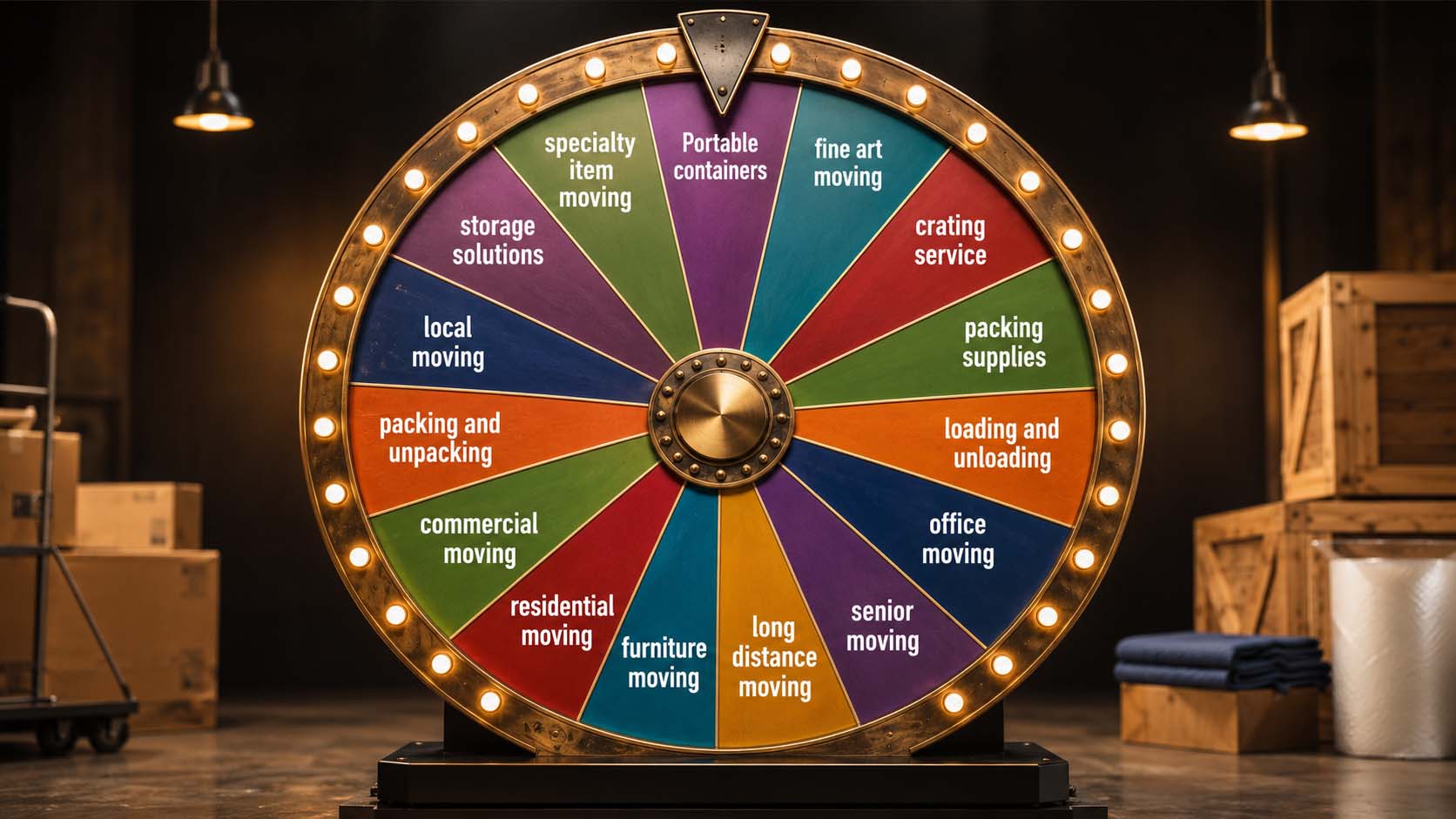
Not every move needs the same kind of service.
Some customers need a full crew, truck, packing help, furniture protection, loading, transportation, and unloading. Others only need labor to load a rental truck or portable storage container. Some moves are local and can be handled in one day. Others are long distance, interstate, staged through storage, or coordinated through a national van line.
The problem is that moving services are often described with overlapping terms.
A customer may hear:
Local moving
Long distance moving
Interstate moving
Intrastate moving
Statewide moving
Van-line service
Direct service
Labor-only service
Container moving
Portable storage
Packing service
Specialty item moving
Commercial moving
Residential moving
Those terms sound simple, but they can mean very different things depending on the company.
This guide explains the major moving service types in plain English so you can understand what you are actually buying, what questions to ask, and which service model fits your move best.
Before breaking down individual services, it helps to understand the larger service models.
Most moves fall into one of these categories:
Each model has a different responsibility structure.
That matters because the most important question is not just, “How much does it cost?”
The better question is:
Who is responsible for the move from start to finish?
Local moving usually refers to a move handled within the same city, metro area, or nearby region.
For a Tucson customer, this might mean moving from one home to another within Tucson, Oro Valley, Marana, Vail, Sahuarita, Green Valley, Catalina Foothills, or another nearby community.
Local moves are often priced by time. That may include:
Crew size
Truck size
Hourly rate
Minimum hours
Travel time
Packing materials
Specialty item charges
Stairs or access complications
Additional stops
Heavy items
Disassembly and reassembly
A local moving service may include loading your furniture and boxes, protecting furniture with moving blankets, transporting everything to the new address, unloading, placing furniture where it belongs, and basic reassembly when included.
A full-service local move may also include packing, unpacking, boxes, supplies, and specialty handling.
A basic local move may only include labor, truck, and transportation.
Local moving is best for customers moving within the same general service area who want a professional crew to handle the physical work and transportation.
It is especially useful for:
Apartment moves
House-to-house moves
Condo moves
Senior moves
Same-day moves
Short-distance moves
Local office moves
Furniture-only moves
Moves with stairs or heavy items
Customers who do not want to rent or drive a truck
Before booking a local mover, ask:
Is this priced hourly or flat-rate?
Is travel time included?
What is the minimum charge?
How many movers are included?
What truck size will be used?
Are furniture blankets included?
Are supplies included or extra?
Are stairs, elevators, or long carries extra?
What happens if the move takes longer than expected?
A good local mover should be able to explain the pricing before moving day.
Direct moving service means the same company handles the move directly instead of passing the job through a broker, van-line network, or multiple carriers.
In a direct-service move, the company you hire is typically the company that sends the crew, truck, equipment, and supervisor.
For local moves, most reputable independent movers operate this way.
For long-distance moves, direct service can mean the mover loads your shipment, drives it directly or mostly directly to the destination, and unloads it without transferring your belongings through a large van-line system.
Direct service can create clearer accountability.
The customer knows:
Who is showing up
Who employs the crew
Who owns or controls the truck
Who is responsible for communication
Who handles claims
Who controls scheduling
Who to call if there is a problem
Direct service can also reduce confusion because there are fewer handoffs.
Direct service is best for customers who want a clear relationship with one moving company.
It is especially helpful for:
Local moves
Regional moves
Statewide moves
Small long-distance moves
High-trust residential moves
Customers who want fewer handoffs
Customers who want clearer accountability
Direct service may be less available for very long cross-country moves, very large shipments, or moves outside the company’s service region.
A smaller direct mover may also have fewer trucks, fewer long-distance routes, or tighter scheduling capacity than a national van line.
Ask:
Are you the company physically performing my move?
Will your employees handle the move?
Will my belongings stay on the same truck?
Will the shipment be transferred?
Who drives the shipment?
Who handles communication during transit?
Who handles damage claims?
The goal is to understand whether the service is truly direct or simply being sold as direct.
Van-line service usually refers to a national or large regional moving network.
A van line may have many agents in different cities. One local agent may book or origin-service the move, another may provide the driver or linehaul, and another may handle delivery at the destination.
Well-known van-line systems can be useful for large interstate moves because they have broader geographic coverage, established long-haul networks, and coordination across multiple markets.
A van-line move may involve:
A local booking agent
An origin crew
A long-haul driver
A destination agent
Warehouse handling
Shipment consolidation
Delivery scheduling windows
A tariff-based pricing structure
Different crews at pickup and delivery
This can be efficient for interstate moving, but it also means the customer should understand who is responsible for each stage.
Van-line service can be a good fit for:
Large interstate moves
Cross-country moves
Corporate relocations
Military-style relocation needs
Moves requiring national coverage
Moves that need origin and destination agents
Customers who want a larger network
Van-line moves can involve more handoffs than a direct move.
Possible issues include:
Wider pickup and delivery windows
Shipment consolidation
Multiple crews handling the shipment
Communication through several parties
Less personal continuity
Potential storage-in-transit
More complex paperwork
That does not mean van-line service is bad. It means the customer needs to understand the structure.
Ask:
Which van line is involved?
Which local agent is booking the move?
Who is the carrier of record?
Who loads the shipment?
Who drives the shipment?
Will the shipment be consolidated with other shipments?
Will my belongings be transferred?
What is the delivery spread?
Who handles claims?
Who is my single point of contact?
For interstate moves, FMCSA explains that household goods movers and brokers have different roles, and that brokers are not authorized to transport household goods themselves.
A broker arranges a move with another company. A broker may not own trucks, employ the moving crew, or physically transport household goods.
This is important because a customer may think they are hiring a mover when they are actually hiring a sales company that will assign the job to a carrier later.
For interstate moves, FMCSA states that both interstate movers and brokers must be registered, but brokers act as middlemen and are not authorized to transport household goods themselves.
Brokered service can become risky when:
The broker does not clearly disclose its role
The customer does not know who will show up
The quote is based on weak inventory information
The carrier changes the price later
The broker becomes hard to reach after booking
The customer is passed between companies
The paperwork names a company the customer does not recognize
Ask directly:
“Are you the mover, the carrier, or a broker?”
Then ask:
Who will physically perform the move?
What is that company’s legal name?
Will I receive their information before moving day?
Who is responsible if the price changes?
Who handles claims?
Who do I call on moving day?
This question alone can prevent a lot of confusion.
An interstate move crosses state lines.
For example:
Arizona to California
Arizona to Texas
Arizona to Colorado
Arizona to New Mexico
Arizona to Nevada
Arizona to Washington
Even if the move starts locally and ends in a nearby state, it is still interstate if it crosses a state line.
Interstate moves are subject to federal household goods moving rules. FMCSA provides consumer resources for interstate moves, including the “Your Rights and Responsibilities When You Move” booklet and “Ready to Move” brochure.
Interstate moving usually involves more planning than local moving.
Important differences may include:
Federal registration requirements
Different estimate types
Bill of lading requirements
Valuation options
Delivery windows
Longer scheduling timelines
Possible shipment consolidation
Greater risk of delay
More complex claims processes
Different paperwork than local moves
Interstate moving service is needed when your shipment crosses state lines and you want a professional mover to transport your belongings.
Ask:
Are you registered for interstate household goods moves?
Are you the carrier or a broker?
Will you provide required consumer documents?
Is the estimate binding or non-binding?
What valuation options are available?
What is the delivery window?
Will my shipment be transferred or consolidated?
Who handles claims?
For interstate moves, do not treat paperwork as a formality. The paperwork defines your rights, responsibilities, pricing structure, and claims process.
Statewide long-distance moving usually refers to a move that stays within the same state but travels a longer distance.
For example, in Arizona:
Tucson to Phoenix
Tucson to Flagstaff
Tucson to Prescott
Tucson to Sedona
Tucson to Yuma
Tucson to Lake Havasu
Tucson to Show Low
This may also be called an intrastate move because it stays inside one state.
A statewide move may feel similar to an interstate move because the truck travels a long distance, but it does not cross a state line.
That distinction matters because state-level rules may apply instead of federal interstate moving rules.
From a customer’s perspective, statewide long-distance moves often require:
More detailed scheduling
Accurate inventory
Clear pickup and delivery timing
Drive-time planning
Fuel and travel cost clarity
Possible overnight planning
Crew availability at destination
Clear expectations for same-day versus next-day delivery
Statewide long-distance moving is best for customers moving from one city to another within the same state who want direct transportation without renting a truck or container.
Ask:
Is this move priced hourly, flat-rate, or by another method?
Is drive time included?
Will delivery happen the same day?
Will the same crew load and unload?
Will the shipment stay on the same truck?
Are overnight charges possible?
Are fuel, mileage, and travel charges included?
Statewide long-distance moves can be very smooth when the schedule and pricing method are clear.
Long-distance moving is a broad term.
It may mean interstate moving, statewide moving, regional moving, or cross-country moving depending on the company.
That is why customers should not rely on the phrase alone.
A “long-distance move” might be:
A 120-mile move within the same state
A 400-mile move across state lines
A cross-country van-line move
A direct truckload move
A container move
A freight trailer move
A labor-only load into a customer-rented truck
Long-distance moving is best for customers relocating beyond their local metro area who want help transporting household goods to another city or state.
Ask:
Does this cross state lines?
Is this considered interstate or intrastate?
Who transports the shipment?
Will it be direct or consolidated?
Will my items stay on one truck?
What is the delivery window?
How are delays handled?
What documents apply?
What valuation options apply?
The term “long distance” is useful for marketing, but the actual service structure matters more.
Portable container moving is a hybrid between DIY moving, storage, and transportation.
Instead of a full moving truck and crew, a container company delivers a portable storage container to your property. You load it, or you hire labor to load it. Then the container company picks it up and transports it to another location or stores it.
Common container-style services include companies such as PODS and U-Pack.
U-Pack describes its model as a self-moving service where the customer does the packing and loading, and U-Pack drives the belongings. U-Pack offers trailer and ReloCube options and delivery choices such as door-to-door or service-center delivery.
PODS describes its service around portable containers that customers load, with PODS handling transportation and storage options; PODS also emphasizes that the customer does not have to drive the moving vehicle.
The basic process is:
The container is delivered.
The customer loads it or hires loading help.
The container is picked up.
The container is transported or stored.
The container is delivered to the destination.
The customer unloads it or hires unloading help.
The empty container is picked up.
Portable containers are best for customers who want flexibility.
They are especially useful for:
DIY moves
Delayed closings
Remodeling projects
Temporary storage
Long-distance budget moves
Customers who do not want to drive a rental truck
Moves where loading can happen over several days
Customers who want to combine storage and moving
Portable containers can offer:
Flexible loading schedule
Storage built into the process
No need to drive a large truck
Potential cost savings compared with full-service moving
Less pressure than same-day loading
Ability to hire labor separately
Useful staging option during home sales or renovations
Portable containers are not right for every move.
Potential issues include:
Driveway or parking restrictions
HOA restrictions
Apartment access limitations
City permit requirements
Limited container sizes
Customer must load correctly
Weather exposure during loading
Long carries from container to home
Limited availability in some areas
Possible delivery scheduling constraints
Heavy items may still require professional movers
Damage risk if items are poorly packed or loaded
Ask:
What container size do I need?
Where can the container legally be placed?
Do I need a permit?
How long can I keep it?
What happens if closing is delayed?
Is storage included or extra?
How is transportation priced?
Is there a weight limit?
What items are prohibited?
What happens if my items shift during transit?
Do I need professional loading help?
The biggest mistake with container moving is assuming that transportation solves the whole move. The container company may move the container, but the customer is still responsible for packing, loading, securing, and unloading unless separate labor is hired.
Portable container service is a specific service category that often supports DIY, hybrid, and storage-based moves.
A moving company may offer labor to load or unload containers even if the container itself comes from another provider.
For example, a customer may rent a PODS container, U-Pack ReloCube, Pack-Rat container, or similar unit, then hire movers only for the heavy lifting.
Professional loading
Professional unloading
Furniture padding
Tie-down strategy
Space optimization
Disassembly
Heavy item placement
Load balancing
Protection of fragile items
Staging items by priority
Separating unload-first items
Container-to-home transfer
Home-to-container transfer
Portable container loading help is best for customers who like the flexibility of containers but do not want to risk injury, poor loading, or wasted space.
It is especially useful when the container includes:
Heavy furniture
Mattresses
Large dressers
Glass items
Exercise equipment
Fragile items
Stacked boxes
A tight space limit
A long-distance route
A container is only as safe as the load inside it.
Good loading matters because containers can shift during pickup, transport, storage, and delivery. Heavy items should be placed thoughtfully. Fragile items should be protected. Empty space should be reduced. Furniture should be secured.
Saving money by loading poorly can become expensive if items arrive damaged.
Loading and unloading service is often called labor-only moving.
This means the movers provide the physical labor, but the customer provides the truck, trailer, container, storage unit, or transportation method.
Loading a rental truck
Unloading a rental truck
Loading a portable container
Unloading a portable container
Loading a storage unit
Unloading a storage unit
Rearranging a garage
Moving furniture inside the home
Helping with a freight trailer
Helping with a customer-owned trailer
Loading and unloading is best for customers who are managing their own transportation but need professional muscle and loading skill.
It is especially useful for:
Budget-conscious moves
DIY long-distance moves
U-Haul, Penske, or Budget truck rentals
PODS or U-Pack containers
Storage-unit moves
College moves
Small apartment moves
Customers comfortable driving the truck themselves
Labor-only service may not include:
Truck
Fuel
Transportation
Moving blankets
Boxes
Tie-downs
Dollies
Insurance for the customer’s truck
Driving
Full-service move coordination
Some companies bring basic equipment. Others expect the customer to provide supplies. Clarify this before the crew arrives.
Ask:
Do you provide the truck or only labor?
Do you bring dollies and tools?
Do you provide moving blankets?
Do you provide tie-downs or straps?
Can you drive the rental truck?
Are there extra charges for stairs or heavy items?
How many movers do I need?
How long should loading take?
Labor-only moving can be an excellent value, but the responsibility split must be clear.
Residential moving refers to moving household goods from one home to another.
This can include houses, apartments, condos, townhomes, retirement communities, manufactured homes, guest houses, and storage units.
Furniture protection
Box loading
Appliance moving
Bedroom furniture
Living room furniture
Dining room furniture
Patio items
Garage items
Home office items
Packing services
Unpacking services
Disassembly and reassembly
Truck transportation
Placement at the new home
Residential moving is best for customers moving personal household belongings.
It can be local, statewide, interstate, full-service, labor-only, or container-based depending on the situation.
Residential moving is personal. Movers are handling more than objects. They are handling family belongings, memories, important documents, fragile items, children’s furniture, heirlooms, and the pieces of everyday life.
A good residential mover should focus on:
Clear communication
Furniture protection
Floor and doorway awareness
Respect for the home
Careful placement
Customer direction
Accurate scheduling
Practical problem solving
Ask:
How do you protect furniture?
Do you protect floors or doorways when needed?
Do you disassemble beds?
Do you reconnect appliances?
Can you move patio and garage items?
Can you handle fragile items?
Can you pack?
Can you unpack?
Residential moving is the core service most people think of when they hear “moving company.”
Furniture moving can mean a full move or a smaller service focused only on furniture.
Some customers do not need boxes moved. They only need large furniture transported, rearranged, loaded, or delivered.
Moving furniture between homes
Moving furniture within the same home
Rearranging rooms
Moving furniture to storage
Moving furniture for remodeling
Picking up furniture purchases
Moving furniture out for flooring installation
Moving large items upstairs or downstairs
Moving furniture into a garage or staging area
Furniture moving is best for customers who need help with large, awkward, or heavy household items.
This may include:
Sofas
Sectionals
Beds
Dressers
Armoires
Dining tables
China cabinets
Desks
Bookcases
Recliners
Patio furniture
Entertainment centers
Furniture moving is not just lifting.
A good crew thinks about:
Doorway clearance
Stair angles
Wall protection
Disassembly
Blanket wrapping
Load order
Weight distribution
Floor protection
Fragile surfaces
Glass removal
Hardware management
Ask:
Will you wrap the furniture?
Can you disassemble and reassemble it?
Can you move it upstairs or downstairs?
Do you handle tight turns?
Can you move it without damaging walls?
Do you move single items?
Is there a minimum charge?
Furniture moving is often one of the most practical ways to use a moving company for a smaller job.
Packing and unpacking services help customers prepare belongings before the move and settle in afterward.
Packing can be full-service or partial.
Full packing means the movers pack most or all household goods.
This may include:
Kitchen items
Dishes
Glassware
Books
Decor
Linens
Clothing
Lamps
Small appliances
Garage items
Office items
Fragile items
Partial packing focuses only on selected areas.
Common partial packing requests include:
Kitchen only
Fragile items only
Closets only
Artwork only
China cabinet only
Garage only
Last-minute leftover packing
Breakables only
Unpacking may include:
Opening boxes
Removing packing paper
Placing items on counters or tables
Setting up kitchen basics
Removing empty boxes
Organizing by room
Helping the customer get functional faster
Unpacking does not always mean detailed organizing unless that service is specifically included.
Packing and unpacking are best for:
Busy families
Seniors
Corporate moves
Customers with fragile items
Large homes
Last-minute moves
Customers with limited time
Customers physically unable to pack
Moves with kitchens, glassware, or artwork
Ask:
Do you provide boxes and supplies?
Do you charge by box, hour, or project?
Can I pack some items myself?
Can you pack fragile items only?
How do you label boxes?
Do you unpack at destination?
Do you remove packing debris?
What items will you not pack?
Packing is one of the biggest quality differences between a smooth move and a chaotic move.
Packing supplies are the materials used to protect, organize, and transport your belongings.
The right supplies matter because boxes, tape, padding, and protective materials are part of the move’s damage-prevention system.
Small boxes
Medium boxes
Large boxes
Dish packs
Wardrobe boxes
Picture boxes
Mirror boxes
TV boxes
Mattress bags
Packing paper
Bubble wrap
Stretch wrap
Tape
Labels
Markers
Furniture pads
Corner protectors
Floor protection
Moving blankets
Straps
Packing supplies are useful for any customer packing themselves or preparing for movers.
They are especially important for:
Kitchens
Glassware
Artwork
Mirrors
Televisions
Lamps
Books
Fragile decor
Electronics
Mattresses
Long-distance moves
Storage moves
Container moves
Poor supplies create preventable damage.
Common problems include:
Boxes collapsing
Overpacked boxes splitting
Loose items shifting
Glass rubbing against glass
Furniture surfaces scratching
Mattresses getting dirty
TVs being packed incorrectly
Liquids leaking
Hardware getting lost
Ask:
Do you sell or provide boxes?
Are supplies included in packing service?
Are mattress bags extra?
Do you provide TV boxes?
Do you provide wardrobe boxes?
Can unused boxes be returned?
Do you supply labels?
Do you bring stretch wrap and tape?
Supplies are not just add-ons. They are part of the protection plan.
Office moving focuses on business relocations.
This may include moving desks, chairs, files, conference tables, computers, printers, shelving, office supplies, reception furniture, breakroom items, and storage-room contents.
Pre-move planning
Department-by-department labeling
Desk and workstation moving
File cabinet moving
Conference room moving
IT equipment handling
Cubicle disassembly coordination
After-hours scheduling
Weekend moving
Furniture placement
Floor-plan-based unloading
Office-to-storage moving
Business equipment transport
Office moving is best for:
Small businesses
Professional offices
Medical offices
Real estate offices
Law firms
Retail offices
Administrative teams
Startups
Coworking transitions
Commercial tenants
Office moves are not just about furniture.
They are about downtime.
A residential move may be stressful, but an office move can interrupt revenue, staff productivity, phones, computers, client service, and business operations.
Good office moving requires:
Planning
Labeling
Sequencing
Clear access instructions
Building coordination
Elevator scheduling
Parking coordination
After-hours timing
Communication with management
Ask:
Can you move after hours or on weekends?
Can you follow a floor plan?
Do you move file cabinets?
Do file cabinets need to be emptied?
Can you move computers?
Do you disconnect electronics?
Can you coordinate with building management?
Do you provide certificates of insurance if required?
Can you stage departments separately?
Office moving should be planned around business continuity.
Commercial moving is a broader category than office moving.
It may include offices, retail spaces, warehouses, showrooms, studios, clinics, schools, nonprofits, or business storage.
Business furniture
Retail fixtures
Shelving
Equipment
Inventory
Backroom storage
Commercial supplies
Office furniture
Display pieces
Records
Conference furniture
Warehouse items
Business-to-storage transfers
Staged relocation
Commercial moving is best for organizations moving business-related items rather than household goods.
Commercial moves often involve:
Building rules
Loading docks
Elevators
Insurance requirements
Business-hour restrictions
Employee coordination
Multiple departments
Equipment sensitivity
Tighter deadlines
Downtime concerns
Larger furniture systems
More complex access
Ask:
Do you handle commercial moves?
Can you provide proof of insurance?
Can you work with building management?
Can you move after hours?
Can you move equipment?
Can you handle multiple stops?
Can you label by department?
Can you stage the move in phases?
Commercial moving is about logistics, not just lifting.
Senior moving is a more careful, supportive style of residential moving designed for older adults, downsizing households, retirement communities, assisted living moves, or family-managed transitions.
Packing help
Furniture downsizing
Careful room setup
Apartment-to-community moves
Home-to-family moves
Storage coordination
Donation staging
Furniture placement
Unpacking basics
Patient communication
Coordination with family members
Coordination with community move-in rules
Senior moving is best for:
Older adults downsizing
Moves into retirement communities
Moves into assisted living
Moves from a long-time family home
Adult children coordinating a parent’s move
Customers who need extra patience and planning
Customers who may feel overwhelmed by the process
Senior moves can be emotionally complex.
The move may involve leaving a longtime home, sorting decades of belongings, deciding what fits in a smaller space, and coordinating with family or facility rules.
A good senior moving approach emphasizes:
Patience
Respect
Clear communication
Gentle pacing
Careful furniture placement
Family coordination
Reduced chaos
Practical setup at destination
Ask:
Do you help with downsizing moves?
Can you work with family members?
Can you coordinate with retirement communities?
Can you pack and unpack?
Can you place furniture according to a floor plan?
Can you help set up the most important rooms first?
Can you handle smaller, careful moves?
Senior moving is not just a service type. It is a communication style.
Specialty item moving refers to items that require extra planning, equipment, strength, experience, or protection.
Pianos
Safes
Gun safes
Pool tables
Hot tubs
Large appliances
Exercise equipment
Treadmills
Ellipticals
Commercial equipment
Artwork
Antiques
Large mirrors
Glass tables
Oversized furniture
Heavy stone pieces
Aquariums
Arcade machines
Medical equipment
Large sculptures
Specialty item moving is best for customers who have items that are too heavy, fragile, valuable, awkward, or risky for standard moving methods.
Specialty items may require:
Extra movers
Special equipment
Lift gates
Crating
Disassembly
Protective materials
Longer handling time
Route planning
Weight assessment
Stair planning
Door removal
Third-party specialists
Ask:
Have you moved this item before?
How many movers are needed?
What equipment will you use?
Does it need to be disassembled?
Does it require crating?
Can it go upstairs or downstairs safely?
Are there weight limits?
Are there access restrictions?
Is additional valuation available?
Do not assume a standard moving crew can safely handle every specialty item.
Fine art moving is a specialized service for artwork, framed pieces, sculptures, antiques, gallery items, and high-value decorative pieces.
Custom wrapping
Soft packing
Glass protection
Corner protection
Picture cartons
Mirror cartons
Custom crates
Climate considerations
Careful handling
Inventory documentation
Placement planning
Specialty transport coordination
Fine art moving is best for:
Original artwork
Large framed art
Canvas pieces
Glass-covered art
Sculptures
Antiques
Gallery pieces
High-value decor
Sentimental heirlooms
Fragile wall art
Fine art is vulnerable to:
Scratching
Punctures
Frame damage
Glass breakage
Corner damage
Moisture
Heat
Pressure
Improper stacking
Vibration
Handling marks
Fine art should not be treated like ordinary wall decor.
Ask:
Do you offer fine art packing?
Do you use picture boxes or custom crates?
Do you protect glass separately?
Can you document item condition?
Do you handle high-value items?
What valuation options are available?
Will the art be stacked or separated?
Can you move large framed pieces?
For valuable or irreplaceable pieces, packing quality matters as much as transportation.
Crating service provides custom or semi-custom wooden protection for fragile, valuable, oversized, or unusually shaped items.
Crating is often used when standard boxes, blankets, or padding are not enough.
Fine art
Sculptures
Large mirrors
Marble tops
Glass tops
Antiques
High-value furniture
Chandeliers
Fragile electronics
Trade show pieces
Specialty equipment
Museum-style items
Oversized decor
Crating is best for items that are:
High value
Fragile
Irreplaceable
Large
Awkwardly shaped
Difficult to replace
Vulnerable to pressure
Being shipped long distance
Going into storage
Being handled by multiple parties
Crating may include:
Wooden crates
Slat crates
Solid crates
Foam-lined crates
Custom-built crates
Reusable crates
One-way shipping crates
Ask:
Does this item need a crate or just special packing?
Is the crate custom-built?
Is it foam-lined?
Who builds the crate?
How long does crating take?
Can the crate be reused?
Is crating included in the estimate?
How is the item protected inside the crate?
Crating is not always necessary, but when it is necessary, skipping it can be expensive.
Storage solutions help customers bridge timing gaps before, during, or after a move.
Storage may be needed because of closing delays, remodeling, downsizing, staging, lease gaps, temporary housing, or uncertain move-in dates.
Self-storage
Portable container storage
Mover-managed storage
Warehouse storage
Short-term storage
Long-term storage
Storage-in-transit
Garage staging
Business storage
Storage solutions are useful for:
Delayed closings
Home staging
Remodeling
Downsizing
Temporary housing
Military-style transitions
Estate transitions
Business moves
Decluttering before listing a home
Moves with uncertain delivery dates
Self-storage gives the customer more direct access and control.
Mover-managed storage may be more convenient when the moving company handles pickup, storage, and redelivery.
Portable container storage gives the customer loading flexibility and can work well when the container can remain on-site or be stored by the provider.
Ask:
Where will my items be stored?
Can I access them?
Is storage climate-controlled?
How is storage priced?
Is pickup and redelivery included?
Are items inventoried?
What protection applies while in storage?
How much notice is needed for delivery?
Are there minimum storage periods?
Storage is not just a place to put things. It changes the move plan.
These are related, but they are not the same.
Packing supplies are the materials: boxes, paper, tape, wrap, pads, and containers.
Packing service is the labor and skill used to pack your belongings.
A customer can buy supplies and pack themselves.
A customer can hire movers to pack using customer-provided supplies.
A customer can hire movers to provide both supplies and packing labor.
The best choice depends on time, budget, fragility, and how much control the customer wants.
You are moving within the same city or metro area and want a crew and truck.
You want one company responsible for the move with fewer handoffs.
You have a larger interstate or cross-country move that benefits from a national network.
You are moving within the same state but outside your local metro area.
Your belongings are crossing state lines.
You want flexible loading, storage options, and transportation without driving a rental truck.
You are renting your own truck or container and only need professional labor.
You want help protecting fragile items, saving time, or preparing the home faster.
You have fragile, valuable, oversized, or irreplaceable items that need more than normal packing.
The move requires extra patience, family coordination, downsizing help, or careful setup.
You are moving business furniture, equipment, records, workstations, or inventory.
Your move-out and move-in dates do not line up or you need temporary space.
Before booking, ask:
What exact service type am I buying?
Are you providing labor, transportation, packing, storage, or all of the above?
Are you the company performing the move?
Will anyone else handle my belongings?
Is this local, statewide, interstate, or container-based?
How is the price calculated?
What can increase the final cost?
What supplies are included?
What supplies are extra?
What protection or valuation applies?
What happens if the move date changes?
What happens if my inventory changes?
Who do I contact on moving day?
What paperwork will I receive?
The clearer the service type, the easier it is to compare movers fairly.
Moving services are not one-size-fits-all.
A small apartment move across town, a senior downsizing move, a container load, a statewide relocation, and a cross-country van-line move are all “moves,” but they are not the same service.
The right choice depends on distance, budget, schedule, physical difficulty, storage needs, packing needs, and how much responsibility you want the moving company to handle.
The most important thing is clarity.
Know who is doing the work.
Know who is transporting the shipment.
Know whether the move is local, statewide, or interstate.
Know whether the service is direct, brokered, van-line, container-based, or labor-only.
Know what is included.
Know what costs extra.
Know who is accountable if something goes wrong.
A good mover will not make this confusing. A good mover will help you understand your options before moving day.



.svg)