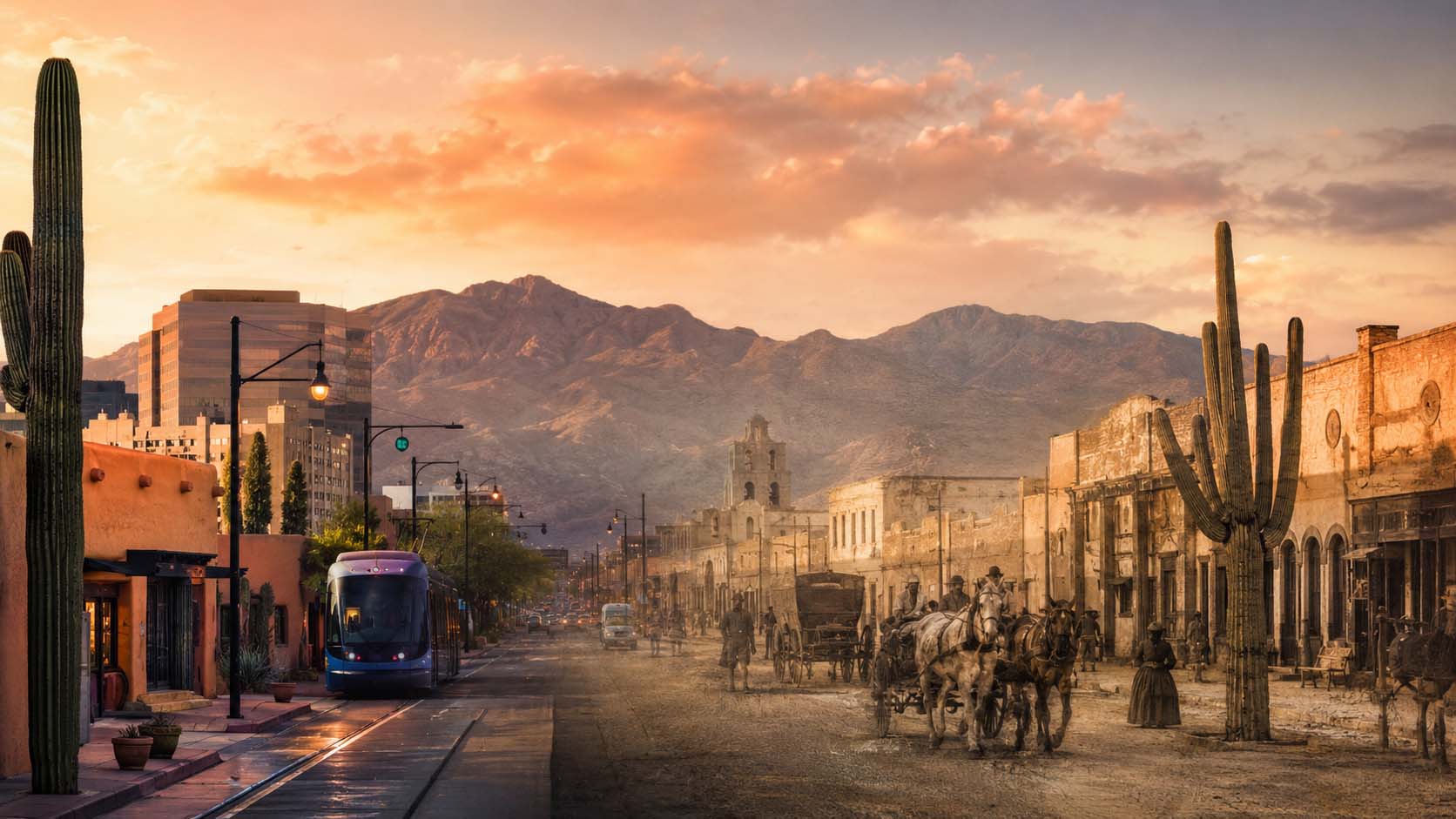
Tucson is not a place where history sits politely behind glass. It shows up in the street grid, the food, the architecture, the names of neighborhoods, the old railroad corridor, the mission church south of town, the University of Arizona campus, the desert landscaping, and the way people talk about the city as The Old Pueblo.
This guide is not meant to be a complete academic history of every group, conflict, neighborhood, or landmark. It is a moving guide orientation: the essential history a newcomer should understand before relocating to Tucson or the surrounding area.
The main idea is simple:
Tucson was not invented as a modern desert suburb.
It grew from thousands of years of human settlement along the Santa Cruz River, then passed through Indigenous, Spanish, Mexican, American territorial, railroad, military, university, suburban, preservation, and modern borderlands eras.
That layering is what gives Tucson its personality.
Tucson is one of the oldest continuously inhabited areas in what is now the United States. Long before the modern city, people lived, farmed, traded, and built communities along the Santa Cruz River. Tucson’s UNESCO City of Gastronomy identity is tied to the region’s unusually long agricultural history, and UNESCO describes Tucson as having the longest agricultural history of any city in the United States.
Spanish colonial influence arrived through missions, presidios, military roads, ranching, and Catholic institutions. Mission San Xavier del Bac was founded by Father Eusebio Kino, and the present church was built by Franciscans between 1783 and 1797. The Presidio San Agustín del Tucson was built in 1775 and became a founding structure of the Spanish colonial settlement that later became Tucson.
After Mexican independence, Tucson became part of Mexico. After the Gadsden Purchase, it became part of the United States. In 1880, the Southern Pacific Railroad reached Tucson and changed the city’s economy, trade routes, migration patterns, building materials, and physical growth.
The University of Arizona was established in Tucson in 1885, before Arizona became a state; Old Main was completed in 1890.
That is why Tucson can feel old and new at the same time.
To understand Tucson, start with the Santa Cruz River.
Today, many newcomers see a dry channel and assume the river is mostly symbolic. Historically, the Santa Cruz was the reason people could live here. It supported farming, settlement, food traditions, travel routes, and communities long before modern groundwater pumping, paved streets, and subdivisions.
The river corridor made the Tucson basin different from open desert. It offered water, floodplain soils, plants, wildlife, and a route through the landscape. The earliest long-term story of Tucson is not a story of downtown buildings. It is a story of people learning how to live along desert water.
This is one reason Tucson’s history is so closely tied to food. Mission Garden and related agricultural-history sources describe thousands of years of farming made possible by the Santa Cruz River and its fertile floodplain.
The history of Tucson begins with Indigenous people.
The Tohono O’odham, Pascua Yaqui, Akimel O’odham, and other Native peoples are not just part of Tucson’s past. They are part of the living region today.
Before the Spanish presidio, before the railroad, before the university, and before statehood, the Tucson basin was already a homeland, travel corridor, farming landscape, and cultural region. People farmed along the river, gathered desert foods, developed water knowledge, created trade relationships, and adapted to the Sonoran Desert in ways that still shape the region’s identity.
A newcomer should avoid thinking of Indigenous history as a vanished first chapter. The Tohono O’odham Nation borders the Tucson area, San Xavier del Bac stands on the Nation, and O’odham place names, foodways, basketry, agriculture, language, and community history remain central to the region.
Tucson’s heritage is not simply Spanish or “Old West.” It is older and more layered than that.
Tucson’s nickname, The Old Pueblo, points to its long Hispanic and Indigenous settlement history.
The phrase is often used casually today, but it carries a real idea: Tucson is an old desert community, not just a postwar metro area. The city grew around a Spanish presidio and nearby mission landscape, but those colonial institutions were placed into an already occupied Indigenous region.
That matters because Tucson’s built environment still reflects older desert settlement patterns: shaded courtyards, adobe walls, plazas, barrios, dense older blocks, porch culture, and public life designed around heat, shade, water, and community.
Modern Tucson has freeways, suburbs, industrial parks, HOAs, research labs, and shopping centers. But the soul of the place comes from older patterns:
Desert water.
Adobe.
Catholic mission influence.
Indigenous food traditions.
Mexican borderlands culture.
Railroad expansion.
A city that grew in layers rather than in one clean master plan.
Spanish colonial influence entered the region through missionaries, soldiers, ranchers, and imperial frontier strategy.
Mission San Xavier del Bac is one of the clearest landmarks of this era. The National Park Service identifies San Xavier del Bac as a National Historic Landmark founded in 1700 by Father Eusebio Kino, with the present church completed by Franciscans in 1797. The mission stands on the site selected at the O’odham village of Wa:k and remains one of the most recognizable historic structures in Southern Arizona.
The Presidio San Agustín del Tucson was established in 1775. A presidio was a fortified military settlement. Tucson’s presidio became the colonial military and administrative center around which the later town grew.
This is why downtown Tucson’s history feels different from a newer Western town founded around a railroad depot alone. Tucson’s Spanish colonial layer came first, and the railroad later changed and expanded the older town.
For movers and new residents, this history explains why older parts of Tucson may have nonstandard lots, narrow streets, unusual building footprints, historic overlays, adobe structures, courtyards, and architectural features that do not behave like typical suburban houses.
After Mexico won independence from Spain in 1821, Tucson became part of Mexico.
This period is essential to understanding Tucson because the city did not simply transition from Spanish to American overnight. Mexican Tucson had its own families, ranching networks, religious life, trade ties, land patterns, language, and borderlands identity.
Many of the cultural qualities people associate with Tucson — food, family networks, plazas, Catholic traditions, Spanish-language place names, Sonoran architecture, barrio life, and cross-border movement — developed through this Spanish and Mexican regional context.
When Tucson later became part of the United States, the people already living there did not disappear. The city became American politically, but it remained deeply Mexican, Indigenous, and borderlands in culture.
That is one of the most important things for newcomers to understand:
Tucson is not simply a U.S. city near Mexico.
It is a borderlands city whose identity was formed through centuries of Indigenous, Spanish, Mexican, and American overlap.
The Gadsden Purchase transferred a large area of present-day southern Arizona and southwestern New Mexico from Mexico to the United States in the 1850s. That changed Tucson’s political future.
American military, legal, business, and territorial systems began reshaping the older Mexican and Indigenous region. English-language institutions expanded. New trade networks grew. Land claims, property rules, military conflicts, and migration patterns changed.
The American period also brought more intense pressure around Apache conflict, mining, freighting, ranching, land speculation, and territorial government.
For new residents, the point is not to memorize a treaty date. The point is to understand that Tucson’s identity sits on a political seam. It carries Spanish colonial history, Mexican sovereignty, Indigenous homeland history, and American territorial development all at once.
The arrival of the Southern Pacific Railroad in Tucson in 1880 was one of the biggest turning points in the city’s history.
Before the railroad, Tucson was more isolated. Goods moved by wagon, trade routes were slower, and the local economy was tied to regional freighting, ranching, mining, military supply, and cross-border commerce.
The railroad connected Tucson more directly to California, the eastern United States, mining districts, manufactured goods, building materials, migration, markets, and national business systems. The Arizona State Museum describes the construction of the Southern Pacific across southern Arizona as a watershed event that linked Tucson and the surrounding region with West Coast shipping ports and eventually the eastern states.
The railroad also helped change what Tucson looked like. New materials arrived. Brick became more common. Commercial buildings changed. Warehouses, depots, rail yards, hotels, and industrial uses clustered around the tracks. The city began to turn toward the railroad corridor, not just the presidio and mission-era settlement pattern.
The railroad also brought workers and communities. Arizona State Museum materials note that Chinese immigrants worked on railroads, in mining and agriculture, and as merchants; African Americans came as soldiers and laborers; and Jewish immigrants became important entrepreneurs in territorial Arizona.
Tucson’s diversity is not a recent add-on. It is part of the railroad, mining, military, trade, and borderlands history of the city.
Arizona was a U.S. territory before it was a state, and Tucson was a major territorial city.
The University of Arizona was established in Tucson in 1885, decades before Arizona statehood. The university’s own history notes that Old Main, the first building, was completed in 1890 and housed the School of Agriculture.
This matters because the university gradually became one of Tucson’s defining institutions. It influenced the local economy, education, medicine, science, sports culture, housing patterns, research identity, and the city’s national reputation.
A person moving to Tucson today may think of the university mostly in terms of traffic, students, sports, employment, medical care, or rental demand. Historically, it represents something larger: Tucson’s transition from a frontier and railroad town into a regional center of education, research, medicine, and innovation.
Arizona became a state in 1912.
By then, Tucson had already passed through Indigenous, Spanish, Mexican, American territorial, military, railroad, and university-building phases. Statehood did not create Tucson; it placed an already old city inside the modern structure of Arizona government.
In the early 20th century, Tucson continued to grow through rail transportation, mining connections, agriculture, health tourism, military presence, university expansion, and a climate marketed to people seeking dry air and sunshine.
This is where Tucson’s image as a desert health and winter destination gained strength. Before air conditioning made desert metro growth easier, Tucson’s climate was sold to visitors, patients, seasonal residents, and investors as a resource.
That history still echoes today in winter visitors, health care, resort culture, retirement communities, and the way Tucson is marketed as a desert lifestyle city.
Tucson’s modern history cannot be separated from aviation and the military.
Davis-Monthan Air Force Base, aviation industries, aerospace contractors, defense-related employment, and the region’s clear skies and open desert all helped shape Tucson in the 20th century.
The military presence also influenced housing, roads, migration, jobs, and the city’s relationship to national defense. Many Tucson residents have military, aviation, or defense connections. The same is true for nearby Southern Arizona communities connected to regional military and border security institutions.
For newcomers, this helps explain why Tucson is not only a university town, retirement destination, or tourism city. It is also a military and aerospace city.
Tucson’s older barrios are central to the city’s identity.
Barrio Viejo and related historic areas preserve adobe architecture, Sonoran row-house forms, courtyards, street-facing walls, cultural memory, and Mexican American community history. Preservation Tucson describes Barrio Viejo as one of the largest surviving concentrations of Sonoran adobe architecture in the American Southwest.
But Tucson’s preservation story also includes loss.
Urban renewal in the 1960s and 1970s demolished large portions of older barrio fabric to make way for modern infrastructure and redevelopment. Visit Tucson’s history of Barrio Viejo notes that the 1970s brought major demolition under urban renewal, causing the loss of homes, memories, and community, while also strengthening preservation awareness.
This history matters because Tucson residents often care deeply about preservation, neighborhood character, displacement, and development decisions. When a newcomer sees a colorful adobe street or historic district, it is not just an aesthetic. It may also be a survivor of a larger story of demolition, resistance, and preservation.
Tucson’s history is visible in its architecture.
Older homes may include adobe, Sonoran row houses, Territorial-style buildings, Mission Revival, Spanish Colonial Revival, bungalows, ranch homes, mid-century masonry houses, and later suburban stucco construction. The University of Arizona’s guide to Tucson historic neighborhoods describes many of these building types across the city’s historic areas.
Each style tells part of the city’s timeline.
Adobe and Sonoran row-house forms point toward older desert building traditions that used mass, shade, courtyards, and street walls to respond to heat.
Mission Revival and Spanish Colonial Revival show how Tucson and the broader Southwest reinterpreted Spanish and Mexican imagery during later periods of American development.
Bungalows and early 20th-century homes reflect Tucson’s connection to national housing trends after the railroad.
Ranch houses and masonry subdivisions reflect the postwar period, automobile growth, and desert suburbanization.
Contemporary desert homes, foothills architecture, and master-planned communities show the modern era of view lots, design review, HOAs, and lifestyle real estate.
This is why Tucson’s neighborhoods can shift quickly from historic adobe to mid-century ranch to newer suburban stucco.
The built environment is a timeline.
Tucson’s history is also a water story.
The ancient and historic city grew near the Santa Cruz River, but modern metro growth relied heavily on groundwater, infrastructure, conservation, and eventually larger regional water systems.
Newcomers should understand that desert living is never separate from water. Landscaping, washes, floodplains, monsoon drainage, groundwater history, water conservation, and xeriscaping are all part of Tucson’s modern civic identity.
This is one reason Tucson often feels more desert-conscious than some other Sun Belt cities. Water limits, heat, native plants, shade, and drainage are not side topics. They are part of the city’s historical survival.
Tucson’s food reputation is not just about good restaurants.
UNESCO identifies Tucson as a Creative City of Gastronomy and notes that the city has the longest agricultural history of any city in the United States. Visit Tucson’s City of Gastronomy materials connect the designation to more than 4,000 years of agricultural tradition, including native crops and Sonoran Desert foodways.
That is why Tucson food culture feels distinctive. It is not only Tex-Mex or generic Southwestern cuisine. It includes O’odham crops and food knowledge, Mexican and Sonoran influence, mission-era agriculture, ranching traditions, Chinese grocery history, immigrant food businesses, local flour tortillas, mesquite, chiles, beans, squash, corn, cactus fruit, and modern chefs working with heritage ingredients.
For someone moving here, food is one of the easiest ways to understand Tucson history.
The plate often tells the story faster than a textbook.
Tucson’s proximity to Mexico is not a minor geographic fact. It is central to the city’s history.
Families, trade, language, music, food, religion, labor, migration, politics, and cultural identity have crossed the region for generations. The border changed meaning over time, but cross-border connection remained part of life.
This is why Tucson often feels different from inland cities that merely have Hispanic heritage. Tucson is part of the Sonoran borderlands. That means people, goods, customs, conflict, and culture have moved through the region for centuries.
This borderlands identity shapes everything from food and festivals to politics, architecture, language, business networks, family histories, and regional memory.
Tucson has a strong preservation streak because so much has already been lost.
Historic districts, adobe repair, neighborhood associations, heritage organizations, archaeological review, old signs, murals, cultural landscapes, and restoration projects all reflect a civic awareness that history can disappear.
The Arizona Historical Society was established by Arizona’s First Territorial Legislature in 1864 and describes itself as Arizona’s oldest historical agency.
Institutions like the Arizona Historical Society, Arizona State Museum, Mission Garden, the Presidio Museum, San Xavier Mission, and local preservation groups help keep the region’s history accessible.
For a new homeowner, this means older Tucson properties may come with real responsibilities. A historic-looking building may require specialized repair, design review, or greater sensitivity to original materials. Even outside formal historic districts, many Tucsonans value neighborhood character.
A history guide may sound separate from moving, but in Tucson it is practical.
History affects moving in these ways:
Older homes may have narrow doors, low rooflines, nonstandard additions, delicate plaster, adobe walls, courtyard access, and tight lots.
Historic neighborhoods may have limited truck parking, narrow streets, and preservation expectations.
Central neighborhoods may have alleys, street parking constraints, permit issues, or older utility layouts.
Foothills and newer edge areas may have steep drives, gated access, HOAs, long carries, and desert landscaping that must be protected.
Former ranch or rural-edge areas may have unpaved roads, septic systems, wells, outbuildings, animals, or acreage logistics.
University-adjacent areas may have rental turnover cycles, traffic, student housing, and older structures adapted for modern use.
Borderlands and multigenerational family patterns may mean moves are not always simple point-A-to-point-B transactions. Some moves involve storage, family transfers, estate situations, inherited furniture, downsizing, or multi-stop coordination.
Knowing the history helps you read the property and the neighborhood more intelligently.
When you are moving into Tucson, pay attention to these clues:
Is the home adobe, masonry, frame, stucco, or a combination?
Does the lot seem older, irregular, or part of a historic street pattern?
Is the street wide enough for a moving truck?
Is there an alley, courtyard, gate, or rear access that changes the moving plan?
Are there historic-district or HOA rules?
Are there washes, drainage channels, or floodplain issues nearby?
Does the yard use desert landscaping that movers need to avoid damaging?
Is the home near university, downtown, barrio, foothills, retirement, military, or suburban growth patterns?
Are renovations planned immediately after move-in, and do they need permits or design review?
Tucson history is not abstract.
It often shows up in access, rules, materials, and daily living.
Thousands of years ago: People live, gather, farm, and build communities in the Santa Cruz River valley.
Before Spanish colonization: O’odham and other Indigenous communities maintain deep ties to the region.
1690s-1700s: Spanish mission activity expands in the region, including San Xavier del Bac.
1775: The Presidio San Agustín del Tucson is established, anchoring the Spanish colonial settlement that becomes Tucson.
1821: Mexico becomes independent from Spain, and Tucson becomes part of Mexico.
1850s: The Gadsden Purchase brings southern Arizona into the United States.
1860s-1870s: Tucson grows as a territorial, military, freighting, ranching, and regional trade center.
1880: The Southern Pacific Railroad reaches Tucson, transforming the city’s economy and physical growth.
1885: The University of Arizona is established in Tucson.
1890: Old Main is completed at the University of Arizona.
1912: Arizona becomes a state.
Early-mid 20th century: Tucson grows through rail, health tourism, agriculture, military activity, aviation, university expansion, and winter visitation.
Postwar decades: Automobile-oriented growth, ranch houses, subdivisions, air conditioning, defense work, and suburban expansion reshape the metro area.
1960s-1970s: Urban renewal removes portions of historic barrio fabric, strengthening later preservation awareness.
Late 20th century to today: Tucson balances growth, preservation, water awareness, desert conservation, university expansion, borderlands culture, and a renewed appreciation of heritage foodways and historic neighborhoods.
Retirees and seasonal residents are part of Tucson’s modern identity, but the city’s history is much deeper: Indigenous settlement, missions, presidios, Mexican sovereignty, territorial trade, railroad growth, military presence, the university, mining connections, and borderlands culture all came before the retirement-city image.
The Old West is only one layer. Tucson was already an old Indigenous, Spanish, and Mexican place before the classic American frontier period.
The Tucson basin was lived in, farmed, traveled, and understood long before modern development. Desert does not mean empty.
Tucson has its own history, water story, borderlands culture, university-centered identity, preservation sensibility, and Sonoran Desert setting. It is not just a smaller version of Phoenix.
History appears across the region: old barrios, ranch houses, mission landscapes, railroad corridors, university buildings, mining-era links, rural-edge properties, and mid-century neighborhoods.
Tucson rewards people who understand layers.
The city is Indigenous homeland, Spanish presidio, Mexican town, American territorial settlement, railroad city, university town, military and aviation center, borderlands community, desert conservation laboratory, and modern metro area all at once.
That layered history explains why Tucson feels different from many other cities in the Southwest.
It explains the food.
It explains the architecture.
It explains the preservation debates.
It explains the pride in old neighborhoods.
It explains the importance of water.
It explains why the city can feel relaxed, rugged, academic, artistic, military, Mexican, Indigenous, historic, and suburban in the same day.
Moving to Tucson is not just moving to a warm-weather city.
It is moving into The Old Pueblo — a place where the past is still visible if you know how to look.



.svg)