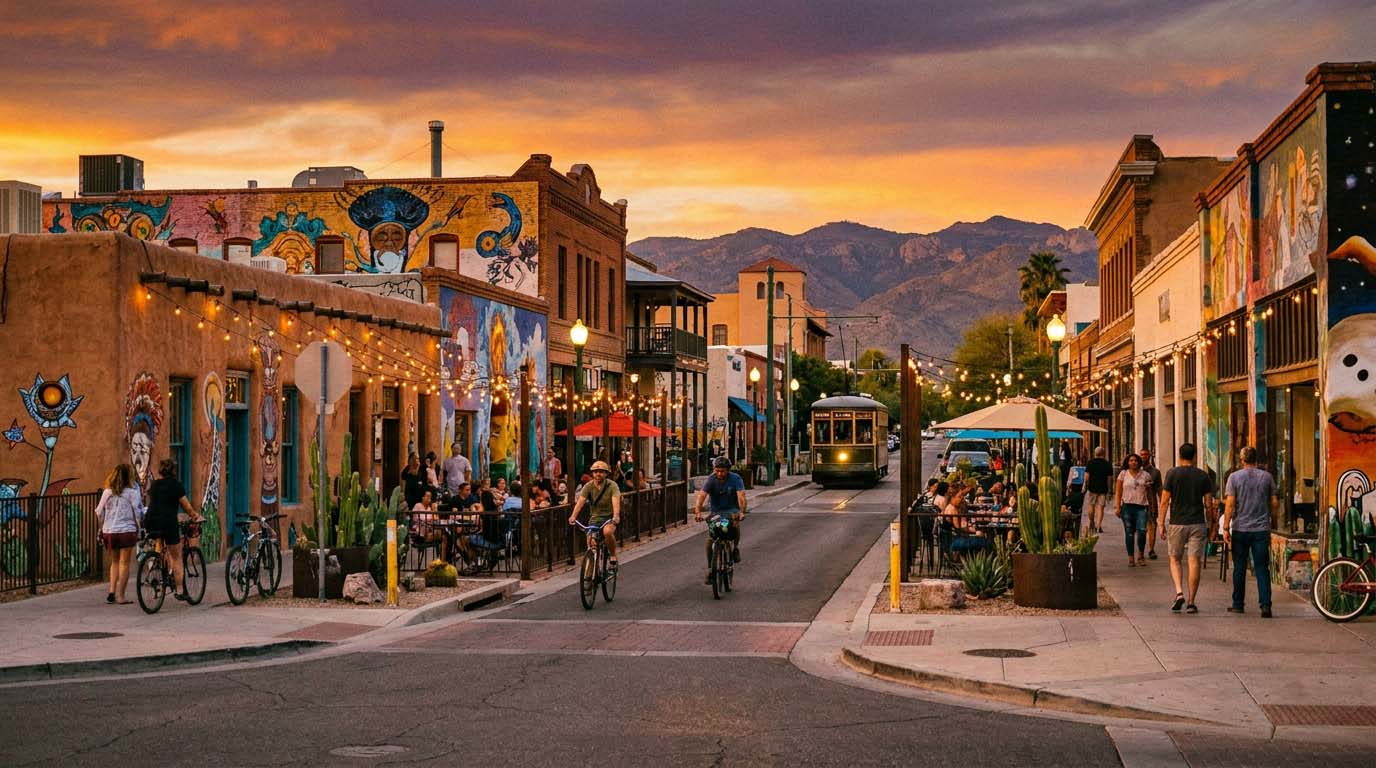
Tucson neighborhoods do not all feel the same. That is one of the best parts of living here.
The metro area can feel historic, desert-rural, suburban, foothills-oriented, university-adjacent, retirement-focused, acreage-based, or master-planned depending on where you land.
This guide is not a neighborhood-by-neighborhood ranking. Those more specific guides can come later. This is the broader orientation: what a newcomer should generally understand before moving into a Tucson-area neighborhood, whether the address is inside the City of Tucson, in unincorporated Pima County, or in surrounding communities such as Oro Valley, Marana, Sahuarita, Vail, Catalina Foothills, Green Valley, or the northwest and southeast edges of the metro area.
The biggest lesson is simple:
In Tucson, the house, the lot, the road, the HOA, the wash, the utility setup, and the jurisdiction all matter.
Two homes ten minutes apart can come with very different rules, maintenance expectations, architecture, drainage realities, and move-in logistics.
Tucson is not built like a dense East Coast city, and it is not quite Phoenix either.
The Tucson area spreads through the Sonoran Desert basin, framed by mountain ranges, washes, arroyos, older street grids, mid-century subdivisions, newer master-planned communities, foothills roads, and pockets of rural-feeling residential land.
Many buyers and renters are surprised by how quickly the character changes.
A street with older masonry ranch homes can be close to a newer gated subdivision.
A home with no HOA may sit near a master-planned community with strict architectural rules.
A central neighborhood may have historic overlay considerations, while a newer edge-area neighborhood may have design guidelines, common-area dues, and private streets.
When you move here, do not judge the area only by a map pin. Drive the access routes, look at the street width, observe parking patterns, notice whether roads are public or private, check whether a wash or drainage corridor is nearby, and ask what jurisdiction controls the address.
A Tucson mailing address does not always mean the home is inside the City of Tucson.
Some properties with Tucson-style addresses are in unincorporated Pima County. Others may be in Oro Valley, Marana, Sahuarita, South Tucson, or another local jurisdiction.
This matters because rules and services can vary.
Trash service, code enforcement, permits, short-term rental rules, parking enforcement, street maintenance, animal rules, zoning, and building inspections may depend on where the property is legally located.
Before moving in, confirm the jurisdiction for the address. Then check the city, town, county, and HOA rules that apply.
A neighbor may say, “Tucson lets you do this,” but the correct answer may be different in Oro Valley, Marana, Sahuarita, unincorporated Pima County, or inside a private HOA community.
When scheduling movers, containers, or deliveries, verify whether the street is public, private, gated, narrow, permit-restricted, or controlled by an HOA.
This can affect:
Truck parking
Container placement
Gate codes
Elevator reservations
Move-in hours
Commercial vehicle rules
Where movers can safely stage equipment
Tucson-area housing is visually diverse.
The Old Pueblo has deep regional architecture, but everyday housing also includes practical desert construction from many eras.
The University of Arizona’s guide to Tucson historic neighborhoods describes a wide range of local residential building types, including adobe, Sonoran row houses, bungalows, Mission Revival, Spanish Colonial Revival, and postwar Ranch styles. Tucson also has Historic Preservation Zones and historic districts where design review may apply before certain exterior changes or demolition.
Older and regionally expressive homes may use adobe or masonry elements, thick walls, courtyards, shaded entries, and street-facing walls that reflect older Sonoran and Territorial building patterns.
These homes can feel deeply Tucson.
They can also require more careful move planning because older homes may have tight thresholds, unique plaster surfaces, built-ins, narrow gates, or unusual access routes.
Many established Tucson-area neighborhoods include low-slung postwar ranch homes, carports, masonry construction, large windows, modest rooflines, and practical layouts suited to desert living.
These homes may have easier single-level access, but they can also have narrow hallways, older doors, low carports, tight laundry rooms, and additions that were built over time.
Stucco walls, parapets, exposed wood details, flat or low-slope roofs, shaded patios, courtyards, and earth-toned exteriors appear throughout the region.
This style can be beautiful, but homeowners should pay attention to roof drainage, parapet maintenance, wall surfaces, exterior repainting needs, and HOA or historic restrictions.
Arches, tile roofs, courtyards, decorative iron, carved doors, and stucco exteriors can show up in both older and newer homes.
For moving purposes, decorative gates, arched entries, tile steps, and courtyards can be access issues. A furniture piece may technically fit through the front door but not through the courtyard approach.
Newer builds may emphasize open plans, high ceilings, large glass, covered patios, synthetic stucco, tile roofs, pavers, and low-water landscaping.
These homes may be easier for movers in some ways, but they often come with HOA rules, strict driveway limits, garage storage restrictions, and landscaping that cannot be damaged without consequences.
Tucson also has many lower-maintenance housing types, especially in retirement-oriented, investor-owned, or HOA-managed communities.
These moves may involve narrower interior spaces, parking restrictions, community rules, elevator reservations, shared walls, and strict quiet hours.
Architecture is not just aesthetic.
It affects the move.
Older central homes may have narrower doors, low clearances, tight turns, small driveways, detached garages, limited curb space, or historic finishes that need extra protection.
Foothills homes may have steep driveways, long carries, stairs, split-level layouts, fragile hardscape, and limited truck turnaround space.
Newer subdivisions may have wider streets and garages but stricter HOA rules about truck timing, container placement, and visible storage.
Adobe or older masonry homes may have delicate plaster, thick walls, unique thresholds, and built-in features that make large furniture navigation less predictable.
Townhomes and condos may involve elevators, common corridors, reserved parking, insurance certificates, move-in windows, and strict loading-zone rules.
The best moving estimate is not based only on bedroom count.
It should also account for access.
Tucson has historic areas, older districts, and architecturally significant streetscapes.
You do not need to live in a museum district to feel this, but some properties are subject to more formal rules.
The City of Tucson explains that Historic Preservation Zones are zoning overlays, and historic approval may be required before demolition or certain exterior work in those zones.
For a new resident, the practical takeaway is this:
Before changing windows, demolishing structures, altering exterior walls, adding major features, changing visible materials, or modifying a property in a historic or overlay area, check first.
A contractor saying “we do this all the time” is not a permit determination.
This matters for moving too.
If you are buying an older home and planning renovations right after the move, coordinate the sequence. Storage, temporary furniture placement, pod placement, driveway work, and demolition schedules may be affected by permits, historic review, HOA approval, or contractor access.
Many Tucson-area neighborhoods have no HOA.
Many others do.
In the Tucson metro, HOAs are especially common in newer subdivisions, gated communities, master-planned areas, townhome and condo developments, retirement-oriented communities, and neighborhoods with shared amenities or private roads.
HOAs can be helpful or restrictive depending on your expectations.
They may maintain common areas, private streets, gates, landscaping, pools, community walls, amenities, or architectural consistency.
They may also regulate:
Exterior colors
Landscaping
Parking
Trash cans
Trailers
Visible storage
Holiday decorations
Rentals
Additions
Solar equipment
Fences
Sheds
Moving containers
Arizona law requires resale disclosure materials for planned communities, including governing documents such as bylaws and rules, the declaration, and association contact information.
Review these documents before closing, not after the moving truck arrives.
Ask:
Are moving trucks allowed on all streets, or are there route restrictions?
Are portable containers allowed? If yes, for how many days?
Are there move-in hours, elevator reservations, gate procedures, or insurance requirements?
Can trailers, RVs, boats, work trucks, or moving equipment be parked overnight?
Are exterior storage boxes, sheds, or temporary garage overflow visible from the street prohibited?
Are landscaping changes or tree removals subject to approval?
Are paint colors, gates, fences, solar features, patios, awnings, or shade structures controlled by architectural review?
Are short-term rentals restricted by CC&Rs even if local law allows them?
Ask the seller, landlord, property manager, or HOA for move-in rules in writing.
A violation notice during the first week is a bad way to meet the neighborhood.
Tucson-area streets vary widely.
Some are wide and easy for a 26-foot box truck.
Others are narrow, curved, steep, private, gated, permit-restricted, or lined with desert landscaping and drainage features.
Inside the City of Tucson, city parking code materials include sections covering unattended and inoperable vehicles, truck parking, and recreational or commercial vehicles. Tucson City Code Section 20-263 says it is unlawful to park a recreational vehicle or commercial vehicle on the same block of a street or right-of-way for any portion of two consecutive calendar days.
The City also has neighborhood parking permit areas in some locations. In those areas, permits and enforcement rules may apply.
HOAs and apartment communities may be stricter than city code.
They may limit overnight truck parking, trailers, pods, commercial vehicles, visible work trucks, or loading activity.
In some communities, the easiest legal place to park a moving truck may still violate HOA rules.
Measure or photograph the driveway and street approach before move day.
Ask whether the truck can block the driveway, park at the curb, use a loading zone, or enter a gated area.
Confirm whether a container, trailer, or rental truck can remain overnight.
Check whether the street has permit parking, fire lanes, HOA restrictions, or private-road rules.
If the move involves a condo, apartment, or retirement community, reserve elevators and loading areas early.
Tucson neighborhood rules are not just about HOAs.
The City of Tucson has a Neighborhood Preservation Ordinance and code enforcement processes for exterior property issues. The city lists examples such as excessive storage or unscreened storage, vegetation over 6 inches, junked or inoperable vehicles, refuse accumulation, dilapidated structures or fences, peeling exterior paint over more than 50 percent of a building, and unsecured pools and spas.
Pima County also operates code compliance for unincorporated areas, including zoning, building code, and illegal dumping complaints.
For newcomers, this means Tucson is casual in some ways but not rule-free.
A front yard full of move-in debris, cardboard, broken furniture, weeds, or disabled vehicles can become a neighborhood issue.
This is especially true after a move, remodel, estate cleanout, or DIY landscaping project.
Plan trash and bulk disposal before the move.
Cardboard, old furniture, packing paper, appliances, mattresses, and remodel debris can pile up quickly.
If you are moving into an HOA or condo, ask where move-in debris can go.
Do not assume you can leave a mountain of boxes by the curb indefinitely.
Tucson neighborhoods can be relaxed, but noise expectations still matter.
Move-ins, remodels, roof work, pool equipment, landscaping, dogs, parties, short-term rentals, and early-morning construction can all create friction.
Rules depend on jurisdiction, zoning, HOA covenants, and sometimes permit conditions.
Even where enforcement is not immediate, neighbor relationships matter.
A move that blocks a street, starts too early, leaves debris, or runs loud equipment late can create a bad first impression.
Tell nearby neighbors if a large truck, container, or contractor will temporarily affect access.
Avoid unnecessary early-morning or late-night loading noise.
Do not block driveways, mailboxes, sidewalks, fire lanes, or narrow street turns.
Keep dogs, gates, and desert wildlife hazards controlled during the move.
Break down boxes and manage debris quickly.
If you are renovating immediately, confirm allowed work hours with the city, county, HOA, or community manager.
Many Tucson yards are not traditional grass lawns.
Expect gravel, decomposed granite, cactus, native trees, desert-adapted shrubs, irrigation systems, rainwater features, rock borders, washes, courtyard walls, and shade structures.
Tucson Water provides landscape resources based on local research and conservation expertise. Its plant guidance notes that hundreds of water-thrifty native or desert-adapted plants are available locally. Tucson’s development standards also include water-conserving landscape design principles, including grouping plants with similar water needs and using efficient irrigation systems.
A newcomer may see a desert yard and assume it is maintenance-free.
It is not.
Desert landscaping still needs weed control, irrigation checks, tree trimming, cactus awareness, pest awareness, drainage maintenance, and seasonal cleanup.
Weeds can explode after monsoon rains.
Gravel can migrate onto sidewalks and driveways.
Mesquite and palo verde trees may need professional trimming for roof, wall, and driveway clearance.
Cactus, agave, ocotillo, and thorny plants can make furniture carrying more difficult.
Irrigation leaks can be hidden until the water bill jumps.
Some plants are protected, restricted, HOA-controlled, or difficult to remove without proper advice.
Shade is a real quality-of-life feature, not just landscaping decoration.
Tucson is in the desert, but water is still one of the most important neighborhood issues.
Many washes are dry most of the year and then carry fast-moving stormwater during monsoon season.
Flooding, erosion, driveway washouts, low-water crossings, and drainage patterns can affect homes that look perfectly dry in normal weather.
Pima County flood-control materials note that arid-region watercourses may be dry until severe rain events and then can be subject to flash flooding and lateral movement. The City of Tucson’s floodplain planning materials also emphasize rainfall data, watercourse gauges, post-fire inundation risk, and storm awareness.
When choosing a Tucson-area home, do not ignore nearby washes, drainage easements, sloped lots, road dips, culverts, retaining walls, or evidence of erosion.
These features may affect insurance, landscaping, fencing, driveway access, and where a moving truck or container can safely be placed during storm season.
Ask whether the property is in or near a mapped floodplain or erosion hazard area.
Look for drainage easements on the survey, plat, title documents, or HOA materials.
Avoid placing containers or heavy trucks where water flows during storms.
Do not block washes, swales, culverts, or drainage paths with debris, landscaping, or storage.
If moving during monsoon season, build weather flexibility into the schedule.
In many Tucson-area neighborhoods, especially near washes, open desert, foothills, and edge communities, wildlife is part of daily life.
Residents may encounter coyotes, javelina, snakes, scorpions, bobcats, birds of prey, and many smaller desert animals.
This affects move-in routines.
Gates left open, garage doors propped up, food waste, pet bowls, unsecured trash, and open boxes in the garage can invite problems.
Pets should be secured during moving because doors stay open, workers move in and out, and unfamiliar sounds can trigger escapes.
Keep pets in a closed room, crate, or off-site during active moving.
Check the yard fence before letting pets roam.
Do not leave pet food, trash, or unpacked pantry items outside.
Use caution around stacked boxes, garages, sheds, and patios where pests may hide.
Ask neighbors about common wildlife patterns before walking pets at dawn or dusk.
Tucson-area homes may use different utility and home-system setups depending on age, jurisdiction, and location.
Expect variation in:
Electric providers
Water providers
Sewer versus septic
Natural gas availability
Propane in some areas
Private trash service in some county areas
Irrigation systems
Pool equipment
Evaporative cooling in older homes
Solar systems
Before move-in, verify which services transfer automatically and which require a new account.
Some addresses with a Tucson mailing address may not use the same city services as a property inside city limits.
Confirm electric, water, gas, sewer or septic, trash, recycling, internet, and alarm transfer dates.
Ask whether the property has an irrigation controller and where shutoffs are located.
Locate the main water shutoff before moving furniture against walls or into utility areas.
Ask about pool service, filters, timers, and equipment access if applicable.
For older homes, ask about swamp or evaporative cooling, roof type, electrical panel age, and plumbing updates.
If solar is present, confirm ownership, lease, monitoring, transfer, and roof access issues before closing.
Short-term rental rules in Arizona are shaped by state law and local ordinances, and they can differ between Tucson-area jurisdictions.
Oro Valley and Marana, for example, publish short-term or vacation rental requirements that include registration or licensing details and neighbor-related requirements. Arizona law also limits how cities and towns can regulate vacation rentals and short-term rentals, while allowing certain permit, contact, tax, insurance, and nuisance-related requirements.
For a new resident, this means short-term rental activity may be part of the neighborhood context, especially in areas attractive to winter visitors, university visitors, medical visitors, event travelers, and seasonal residents.
HOAs may also have their own rental restrictions, so local legality and HOA permission are not always the same thing.
Does the HOA restrict short-term rentals or minimum lease terms?
Does the city or town require registration, licensing, neighbor notification, or a local contact?
Are there frequent guest parking, noise, trash, or party complaints nearby?
If buying as an owner-occupant, are nearby homes mostly owner-occupied, rentals, seasonal, or mixed?
If buying as an investor, confirm both municipal rules and HOA documents before assuming rental use is allowed.
A smooth Tucson move-in is often about timing.
Heat, monsoon storms, HOA rules, elevator reservations, gated access, parking, trash pickup, and utility activation all affect the experience.
Confirm jurisdiction: city, town, unincorporated county, or HOA community.
Request HOA move-in rules, gate codes, container rules, and parking instructions.
Check whether truck access is straightforward or if there are steep, narrow, gated, or private-road conditions.
Schedule utilities and internet early.
Plan disposal for boxes, packing paper, old furniture, and bulk items.
If buying an older home, verify renovation permit requirements before scheduling immediate work.
Confirm arrival window with movers, rental truck, container provider, or delivery crews.
Check weather, especially during monsoon season.
Reserve elevators, loading zones, and gates if needed.
Clear the driveway and walkways of rocks, cactus debris, hoses, tools, and landscape obstacles.
Verify where pets will be during the move.
Keep water available and plan for heat breaks.
Protect walls, floors, doorways, and desert landscaping.
Do not block neighbors longer than necessary.
Keep boxes organized by room so debris and unpacking stay controlled.
Check that the truck or container placement does not block drainage, visibility, or emergency access.
Break down boxes and remove packing debris.
Meet immediate neighbors casually and ask about trash days, drainage quirks, parking patterns, and HOA habits.
Locate shutoffs, breaker panels, irrigation controls, filters, and gate systems.
Check exterior lighting, locks, garage doors, and fence gates.
Watch how water flows during the first rain before making landscaping changes.
Desert yards require different maintenance, not zero maintenance.
Weed control, irrigation, trees, drainage, pests, and gravel all need attention.
Always confirm the legal jurisdiction.
Services and rules can change at city, town, county, and HOA boundaries.
City, county, zoning, nuisance, parking, building, drainage, and historic rules may still apply.
HOAs vary widely.
Some are active and strict. Others are minimal.
Read the documents and budget, not just the entrance sign.
A dry wash can be a real watercourse during a storm.
Drainage is part of Tucson living.
Check HOA, street, driveway, permit, and access rules before ordering a pod or storage container.
Confirm the exact jurisdiction.
Check HOA documents if applicable.
Review parking, truck, trailer, and container rules.
Understand the home style and access challenges before move day.
Check for historic, overlay, or design-review restrictions before exterior work.
Look at drainage, washes, slope, and floodplain context.
Plan for desert landscaping maintenance and water use.
Ask about trash, recycling, bulk pickup, and code enforcement expectations.
Confirm utility providers and shutoff locations.
Prepare for heat, monsoon weather, wildlife, pets, and gate access.
Treat neighbors like part of the move plan, not an afterthought.
Moving into a Tucson-area neighborhood is not just about choosing a house.
It is about understanding the setting around the house.
The Old Pueblo has historic homes, mid-century ranches, adobe traditions, newer subdivisions, foothills properties, master-planned communities, desert lots, townhomes, retirement areas, and edge-of-town neighborhoods that feel almost rural.
That variety is a strength, but it also means the rules and realities are not one-size-fits-all.
The best move-in experience comes from checking the basics early:
Jurisdiction
HOA
Access
Parking
Ordinances
Drainage
Utilities
Landscaping
Neighborhood expectations
Do that, and Tucson starts to make sense quickly.
Ignore those details, and the first week in your new home can become more complicated than it needed to be.



.svg)