Vetting a mover does not need to be complicated.
You do not need a private investigator, a giant spreadsheet, or a long list of secret industry tricks. You mainly need to confirm that the company is real, properly identified, commercially insured, transparent about who performs the work, and visible in the public safety records that matter.
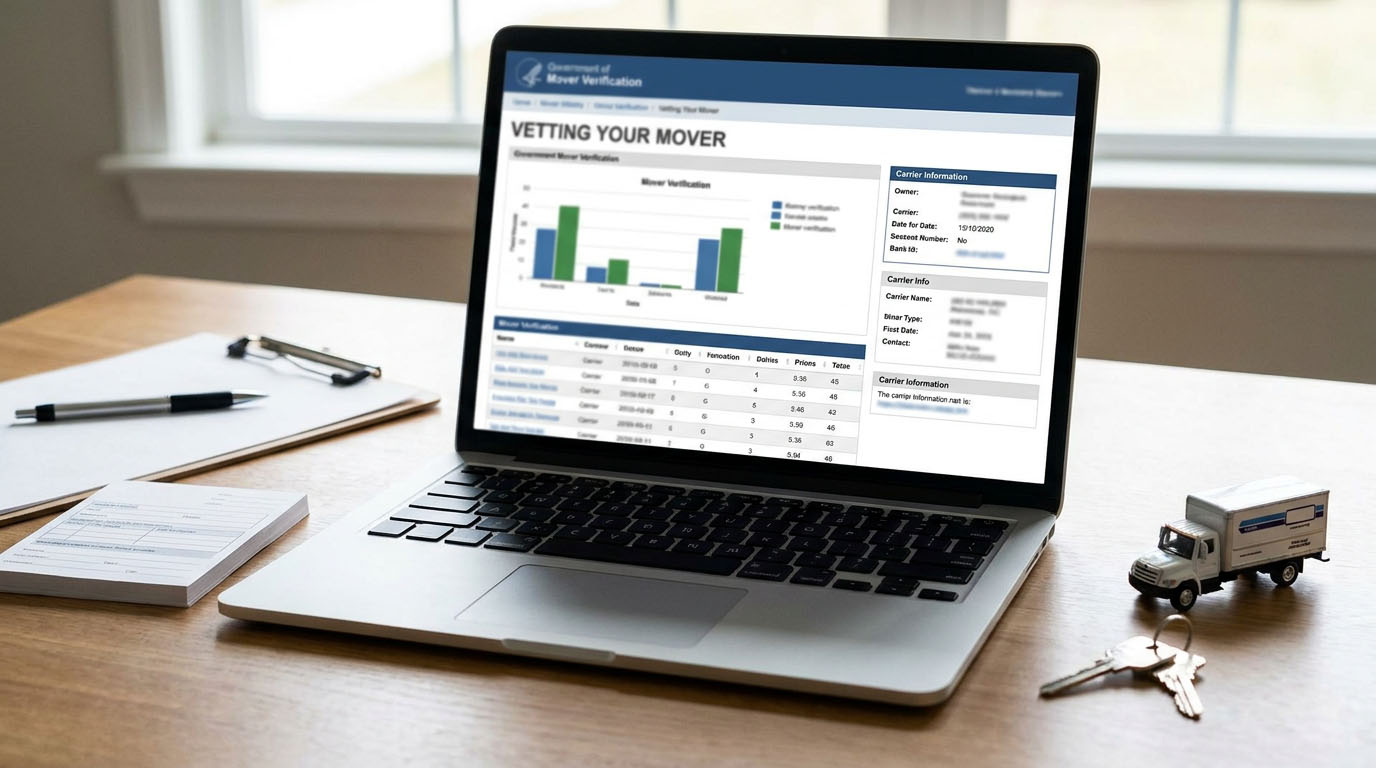
The most important step is checking the company through FMCSA resources. FMCSA says its Company Snapshot is a free public service that shows a company’s identification, cargo information, inspection and out-of-service summary, crash data, and safety rating if one exists. FMCSA also provides a registered mover search for interstate movers that can show registration status, business type, complaint information, and safety information.
For local moves, you still want to run the same basic checks when a mover has a USDOT number or operates commercial vehicles. For interstate moves, do not skip them. Interstate household-goods movers must be registered with the federal government and have a U.S. DOT number.
A good mover should be easy to verify.
The company name should match.
The phone number should make sense.
The address should make sense.
The USDOT number should lead to the company you are speaking with.
The paperwork should match the company identity.
The estimate should be clear.
The insurance answers should be specific.
The review pattern should look like a real operating company, not a temporary sales operation.
If basic facts are hard to confirm, that is the vetting result.
Before you check anything, ask the mover for its exact legal information.
Do not rely only on the website name. Moving companies may use a legal name, a DBA name, a brand name, or a local marketing name.
Ask for:
Legal business name
DBA name, if different
USDOT number, if applicable
MC number, if applicable
Physical business address
Main phone number
Website
Whether they are a carrier, broker, or labor-only provider
This matters because you cannot vet a company accurately if you are searching the wrong name.
If the mover gives you one name on the phone, another name in email, another name on the estimate, and another name in FMCSA records, pause before booking.
This is the core move.
Go to the FMCSA SAFER Company Snapshot search. Search by USDOT number first. A number is cleaner than a name search because names can be similar, abbreviated, or entered differently.
FMCSA states that Company Snapshot can be searched by DOT number, MC/MX number, or company name.
When the record opens, review:
Legal name
DBA name
Physical address
Phone number
Operating status
Entity type or carrier status
Power units
Drivers
Cargo carried
Safety rating, if any
Inspection history
Out-of-service data
Crash information
The goal is not to become a transportation compliance expert. The goal is to see whether the public record matches the company you think you are hiring.
Start with identity.
Does the legal name match the estimate?
Does the DBA match the brand?
Does the address look connected to the company?
Does the phone number make sense?
Then look at operating status.
If the company shows an inactive, out-of-service, or inconsistent status, ask questions before hiring.
Then look at size.
A company claiming to be a large fleet but showing very few power units may not be telling the full story. A small company is not automatically bad, but the public record should not contradict the sales pitch.
Then look at inspections and crashes.
Some inspection history can be normal for commercial carriers. What you are looking for is an obvious pattern of concern, unusually high out-of-service results, or information that conflicts with how the company describes itself.
Finally, remember that no safety rating does not automatically mean unsafe. Many smaller carriers may not have a formal safety rating. Treat the Company Snapshot as a verification tool, not a single yes-or-no score.
If your shipment crosses state lines, use FMCSA Protect Your Move.
FMCSA says its mover search tool is designed to confirm whether an interstate mover is registered. The tool can show headquarters location, contact information, registration status, business type, complaint information, and safety information.
This is where you confirm whether the company is a household-goods carrier, broker, freight forwarder, or another type of business.
That distinction matters.
A carrier transports your goods.
A broker arranges transportation with another company.
A broker can be legal, but it should not pretend to be the company physically performing the move. FMCSA explains that brokers are middlemen and are not authorized to transport household goods themselves.
Ask directly:
“Are you the carrier physically performing my move, or are you arranging the move with another company?”
For interstate for-hire carriers, FMCSA Licensing and Insurance records can be used to check operating authority information. FMCSA describes the Licensing and Insurance carrier search as a public tool for interstate for-hire carriers with granted authority or pending applications.
FMCSA also says companies with operating authority must maintain required proof of insurance and designation of agents for process on file to avoid revocation proceedings.
For household-goods motor carriers, FMCSA guidance says they must file proof of both public liability and cargo insurance to obtain interstate operating authority.
Customer translation:
For an interstate mover, do not accept vague insurance claims only. Ask what insurance they carry, what is filed where applicable, and what valuation or liability options apply to your goods.
Ask simple, direct questions:
Do you carry commercial auto insurance?
Do you carry general liability insurance?
Do you carry cargo coverage where applicable?
Do you carry workers’ compensation or occupational accident coverage for crews?
Can you provide a certificate of insurance if my building requires one?
What protection applies if my goods are damaged?
What is valuation, and how is it different from insurance?
How do damage claims work?
Who handles the claim if another company performs the move?
A professional mover should understand these questions.
You are not asking for trade secrets. You are asking whether the company is operating like a real business.
Drug testing is not something most customers ask about, but it is a fair professionalism question, especially when a company operates commercial vehicles.
FMCSA explains that commercial motor vehicle drivers have drug and alcohol testing rules, and DOT-wide rules govern how testing is conducted and how employees return to safety-sensitive duties after violations.
Ask:
Do drivers who are subject to DOT rules participate in a compliant drug and alcohol testing program?
Do you have written safety policies for drivers and crews?
Do you background check employees or screen new hires?
Are crews employees, contractors, day labor, or subcontractors?
Who supervises the crew on moving day?
Are drivers trained on safe vehicle operation?
Are movers trained on furniture handling and customer-property protection?
Not every mover is operating the same type of vehicle or doing the same type of move, so the exact requirements can vary. The point is not to interrogate the company. The point is to see whether they can answer safety questions clearly.
A vague answer is not automatically disqualifying, but a defensive answer is useful information.
A real local mover should be locally verifiable.
That does not mean every company needs a giant warehouse or showroom, but there should be a stable identity.
Check:
Google Business Profile
Website consistency
Address consistency
Phone number consistency
Photos of real crews or trucks
Local reviews over time
Local service-area references
State business records when available
BBB profile or complaint pattern
Social media activity, when relevant
FMCSA lists poor or nonexistent offices and warehouses as moving red flags, along with phone calls answered generically as “Movers” or “Moving Company” instead of the company name.
For a local move, a company that looks local online but cannot explain where it operates from deserves extra scrutiny.
Do not just look at the star rating.
Look for repeated patterns.
Reviews mention specific crew members.
Reviews describe realistic move situations.
Reviews appear over a long period of time.
The company responds professionally.
Complaints are addressed instead of ignored.
Customers mention communication, care, punctuality, and price clarity.
Repeated price increases
Deposit complaints
No-shows
Last-minute cancellations
Different company showing up
Damage complaints with no response
Hostage-load language
Sudden flood of vague five-star reviews
Many reviews that sound generic
Reviews that mention a broker but the company presents itself as a mover
BBB recommends researching movers, verifying credentials, getting agreements in writing, and using movers with a trusted reputation. BBB also notes that professional movers often wear uniforms, undergo background checks, and provide order numbers or tracking information.
Every mover can eventually get a bad review. You are not looking for perfection.
You are looking for the business model behind the reviews.
The estimate should match what you were told.
Check for:
Correct company name
Correct pickup address
Correct delivery address
Correct move date
Correct services
Crew size or pricing method
Minimum charges
Travel charges
Packing charges
Material charges
Stairs, elevators, or long-carry terms
Valuation or liability options
Cancellation policy
Deposit terms
Payment terms
Change-order process
The FTC warns consumers not to hire movers who ask them to sign paperwork with blank spaces for prices, dates, signatures, or other important information, and not to hire companies that demand cash or a big deposit before the move.
A verbal promise does not protect you if the paperwork says something different.
This is one of the most important vetting questions.
Ask:
Will your company’s crew show up?
Are the movers employees or contractors?
Will the truck have your company name or markings?
Do you ever subcontract moves?
If another company arrives, am I required to use them?
Who handles claims if something is damaged?
Who do I call on moving day?
Who is responsible if the price changes?
A rental truck does not automatically mean a scam. Small companies may rent equipment for overflow, special jobs, or temporary fleet needs.
But surprise rental trucks, surprise subcontractors, or surprise company names are not good signs. FMCSA includes rental trucks arriving instead of a company-owned or marked fleet truck among its moving red flags.
For most ordinary local moves, public reviews and public records are usually enough.
For higher-risk moves, ask for references or proof of relevant experience.
Ask for more evidence when you have:
A large home
A long-distance move
A senior move
Fine art
Heavy items
Appliances
Office equipment
Strict building requirements
High-value items
Multiple stops
Storage involved
A tight closing or lease deadline
References should sound real and relevant.
A mover that claims to specialize in heavy items, offices, senior moves, or long-distance service should be able to explain that process in practical terms.
Before booking, confirm:
Legal name and DBA
USDOT number, if applicable
MC number, if applicable
FMCSA Company Snapshot record
Registered mover status for interstate moves
Carrier versus broker role
Licensing and insurance status where applicable
Commercial auto, liability, cargo, and workers’ compensation answers
Drug-testing or safety-policy answers where applicable
Local address and phone consistency
Review patterns
Written estimate
Written terms
Valuation or liability explanation
Deposit and payment terms
Who physically performs the move
If the company passes these basics, you are usually dealing with a more transparent operation.
If it cannot pass these basics, keep looking.
Look for movers that:
Give their legal name without hesitation
Provide a USDOT number when applicable
Explain carrier versus broker status clearly
Have public records that match their identity
Explain insurance and valuation plainly
Put pricing terms in writing
Have consistent local reviews
Use clear company branding
Answer safety questions professionally
Do not pressure you into a fast deposit
Do not ask for blank signatures
Explain what could change the price
Provide a clear point of contact
Use professional paperwork
The best movers are not hard to vet.
Pause if you see:
No written estimate
Blank paperwork
Cash-only demands
Large upfront deposit
Vague company identity
Mismatched business names
No clear address
Generic phone answer
Broker role hidden or avoided
No explanation of insurance
No clear damage-claim process
Different company scheduled to show up
Reviews about hostage goods or price jumps
FMCSA records that do not match the company
Pressure tactics
A price dramatically lower than every other quote
One red flag may not prove fraud.
Several red flags together tell you enough.
Vetting a mover is simple because the fundamentals are simple.
Verify the identity.
Check FMCSA Company Snapshot.
Use Protect Your Move for interstate moves.
Check authority and insurance where applicable.
Ask who performs the move.
Read review patterns.
Ask about commercial insurance, driver safety, and drug-testing policies when relevant.
Make sure the paperwork matches the promise.
A professional mover will not be offended by basic verification.
The companies that resist simple questions are usually the companies you should avoid.



.svg)